

Something strange happened in my life recently. It fell apart. And I don’t mean one area of my life got shattered and it shifted my lived experience, I mean the entire existence of what I knew as my life — my identity in every element of family, work, health, relationships, and home — all collapsed and dissolved, suddenly and completely.
Truthfully, I am still awakening from shock. But as I began to open my eyes to reality and brush the dirt off my shoulder, I noticed something beautiful, and also very strange…
I am more in love with the little fragments, with each precious debris I can gather, and earnestly more in love with myself, than I have ever been. I am still surprised by this.
I have never been someone who took my life for granted, and yet what I see now, I did not see before.
Most of us are paying attention to something. The question is: to what?
Even though we sincerely try to not take too much for granted, we each, in our own ways, come to soften our gratitude for the small stuff.
We become preoccupied with all the little things that do go wrong and might go wrong.
We get absorbed by the gap between what exists, what could, and the not-quite-perfectly-fulfilled expectation of what we want.
We are so fully occupied in anticipation of all we think we need to overcome, protect, and strive for.
We concentrate so much of our attention on tiny metrics that we disproportionally inflate their significance.
We spend all our energy optimizing and improving so that we confuse ourselves about what even matters and miss the quiet goodness stitched into ordinary life.
It’s been almost 30 years since psychotherapist Richard Carlson wrote his famous book, Don’t Sweat the Small Stuff…and it’s all Small Stuff.
It was relevant then, but it’s more applicable than ever today, in our culture built on overstimulation, outrage, urgency, and constant comparison. Many people live in a near-permanent state of hypervigilance where the small stuff multiplied exponentially, and we are sweating all of it.
The core encouragement is to not be consumed by the small things, but whether from overwhelm or cynicism, somewhere along the way, many of us also stopped appreciating them.
The risk of getting really good at dismissing little irritations is that we also accidentally start dismissing little joys.
Maybe the real danger of constantly saying “don’t sweat the small stuff” is that eventually, you stop noticing the small stuff altogether and forget that life is made almost entirely of it.
Sometimes we need the big stuff to collapse and fall apart to be reminded that it’s actually all assembled from small stuff. And that small stuff is still here, even if it looks way different when it’s deconstructed.
The way out starts there.
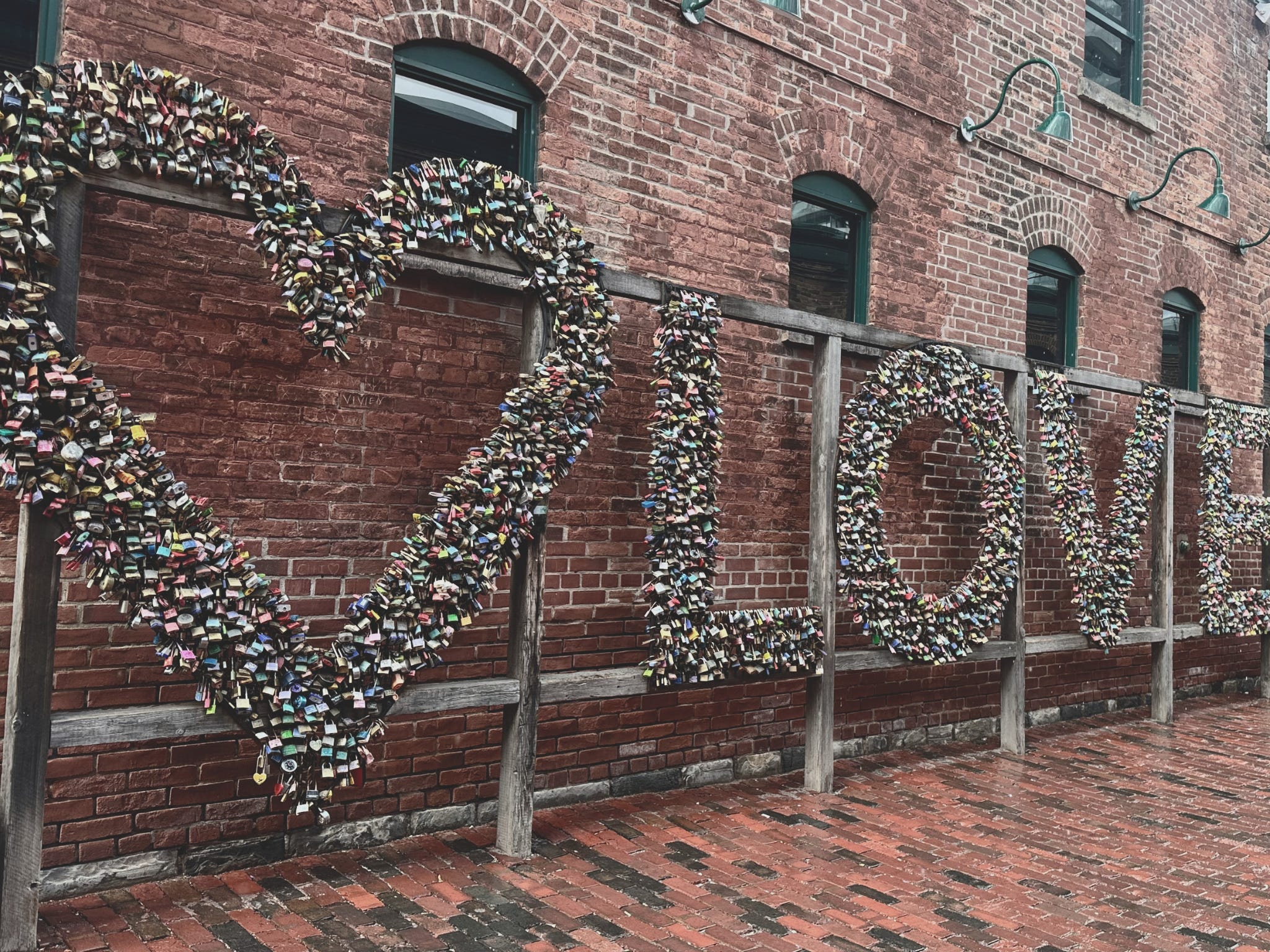
Healing, meaning, and rebuilding happen the way all things do: through tending to the small things, by going brick by brick. The hard part is knowing which bricks will help build your life, and which don’t belong to you at all.
TOO MANY BRICKS IN THE WALL
Most of us have become numb to the small stuff, and frankly that’s a normal reaction to a world that demands we acknowledge everything as a Very Big Deal. Some of it is warranted, but it’s also worth admitting that there are now trillion-dollar industries with business models based on the continuous manufacture and distribution of fear.
How quick, how easy it is to become overburdened by the swelling insistence ordering us, “Here! Now this! You must carry this brick.”
It’s overwhelming. And it feels kind of scary. When we are bombarded by fear, our attention narrowly fixates on survival and self-protection. Our personal reality becomes a long sequence of tangible reasons to be afraid. The more we live in fear, the more our life contracts.
The trouble with endless input is that our mind absorbs more than it deliberately selects. Without fully choosing it, all the small stuff is scanned for threat, harm, and anticipation of pain or loss until any actual presence is eroded by our future-orientation driven by fear.
The particular intimacy with how life feels for each of us is shaped more by what we choose to notice and receive, and less by what happens.
“Small things are often more dangerous than big things, for they can get in through small openings.” — Philomon Sylvester
But the same openings that let in small harms are the very same that let in small goodness. The difference is in what we are oriented to receive. What we fail to choose gets mistaken for what is happening to us and what we fail to notice gets completely missed as if it never happened at all.
This is why fear is so corrosive to love specifically because love requires our presence.
Love is an active orientation that asks us to expand our perception to observe more of the small stuff in what is with us now in the present.
But in practice, this is not always as straightforward as it sounds. Often it is pain that opens our perception of reality involuntarily. Unwelcome loss has a particular way of commanding our attention.
Pain imposes the truth of what is upon us, thrusting our senses into the present whether we like it or not. It pins us to a moment in time often against our will, even when we would rather be anywhere else, in any other version of reality than this one.
Where fear prevents our presence, pain demands it. Even those who have become masters at avoidance and denial are penetrated by the unwelcome arrival of what really hurts.
Fear orients us to an imagined future that doesn’t exist.
Pain is the arrival that forces us to face what is happening and what has happened. You can’t anticipate your way out of it — it’s already here.
Fear and pain feel like similar emotional territory because they are both hard and they both hurt; but where fear pulls us out of reality, pain smashes us into it.
The less we try to flee, shun or avoid it, and the more we allow it, crashing into the now and confronting loss enables us to feel more alive again, if only in a truly terrible way.
It’s precisely through this sharp collision with presence that we become more porous, more present, more awake to what’s legitimately here. Sometimes we need to be pierced by pain to awaken from the numbness of fear. And through the strange ways we are rearranged by suffering, something within us begins to orient itself toward love.
My orientation began to shift with the fragrance after rain. I love rain. It rained a lot in the place I called home, but had to leave. It rained too much, or so thought many people. But not me. For me, rain was a summon to connect with the day. You have to think about what you’re doing when it’s raining outside. The usual response is to grab an umbrella, but I never did.
The impression of countless water clusters hurrying home-bound to the earth beneath us all reminds me how I am not separate from this world, but united with it. I find rain comforting, inspiring, even a little romantic. Rainy days beckon us to slow down, look around, and slip into a luxurious contemplation of all that feels almost-forbidden in the rush of an outcome-driven world.
Walking around in the rain is a spiritual experience. Rain drops fall spontaneously, plopping themselves on our heads, our ears, our nose, so naturally and uninhibited by any desire to splatter themselves well, accurately, or in a certain way.
When it rains, my attention collapses from its ordinary structure of filtering the world into useful pieces. The vast expression of a world in motion rescues me from endless conceptual ideations, and returns me to a more immediate and tactile reality. The breathing world is arbitrary and exposed; so different from the coherent backdrop we project onto it, which is easier to ignore.
The world springs to life when it rains. Even once the rain stops, traces of it persist, reminding us how even briefly, we also were able to clear our world of excess.
The smell after rain is like the earth remembering that it is Earth, real and alive — a formidable force awakening to the power of what it truly is. Rain makes me feel this way, too, real and alive.
After rain, a vibrant afterlife lingers. The air feels clear, the earth refreshed and open, the sky relieved, the creatures of the land restored, and always, I am more willing to be touched by what is trying to reach me.
Losing the structure of everything felt a lot like surviving a storm.
My whole world had been irrevocably altered. My own self, as I knew it, had also been briefly unmade. It felt surreal to reorient myself inside the very devastation I had been bracing against, but navigating from this new position nudged me to notice what had formerly been so small it never got past the edge of my awareness. My attention was astonished.
At first, I was too stricken with shock to allow anything in. I could see small sparks of life reemerging intellectually, but I was unable to absorb any feeling of touching reality.
Even as new life began to bloom, I held a tenacious dedication to stay attentively bound to my painful experience rather than releasing or escaping it. But I couldn’t cling to time no matter how unwillingly I was pinned to it; now soundlessly slipped into then. How quickly the unobserved present becomes the past.
All the while, the inconsequential things invited me to notice how they were now charged with new meaning. But something within me struggled:
How dare I notice now, celebrate beauty, take delight in the present, feel joy, or trust in love again after everything that it just cost me?
In every way, the depth of my pain, loss, and suffering was a testament to the height and verity of my love. How lucky I am to have experienced something truly my own, so certain in my devotion to it that its absence felt so destabilizing. Was this very pain not also proof that I was capable of great joy, pleasure, and goodness?
There is so much gratitude mingled with my grief that it’s quite impossible to disentangle them, nor am I sure that I should want to. And yet, wasn’t it too soon to start opening myself to what’s lovely in life again? Surely, I cannot hold anything while my arms are still stretched toward everything I can no longer reach.
It was too much at once. I couldn’t possibly accept anything good from deep inside the very bowels of darkness. But even in the deepest void, light persists —it always finds a way to enter.
What is the realization of our fears but evidence that time has the remarkable authority to turn imagination to truth and truth to memory. What we love becomes part of the unreachable past. We can imagine what was lost just as clearly as we once imagined visions for the future, but we can access neither.
Everything that comes also comes to pass. Good or bad, this too, is temporary.
The unshakeable fact of the impermanence of everything is more than just tragic, it’s also poetic. Is there not something in this very moment now that you will miss once it’s gone? What is that thing?
The strength of pain is also a reminder of the promise of it. How can you love it — that person, that place, that little thing you love in the special way that only you do — before the fresh tides of change sweep it into the inaccessible past?
It hurts. Of course it does, that is the reality of loving something sincerely. But if we resist fleeing from it, pain forces the same opening that love depends on.
How dare I open myself to love the little delights of life again?
How dare I not?
HINDSIGHT IS 20/20
I’ve lost many things I loved in my life. Many I had to let go of unwillingly, but each time, what was lost became more beautiful.
When we lose something, someone, someplace we love, we have to navigate how we now relate to what no longer exists. That reorientation requires us to examine the genuine truth about what we know, and consider everything that we don’t.
And in this mystery, in the perplexing collection of various little unknowns, we often get better at loving what’s gone than when it was here. We become more forgiving, more tender and open to possibilities that were too implausible while still inside the complication of our attachment to it, tangling us in webs marked by presumption and expectation.
It’s easier to give our full attention to the past once it’s liberated from the tension of competing with the future-reaching demands of fear and desire.
Falling in love is particularly thrilling because our attention is consumed by the present moment. When this happens, our perception expands to absorb everything it can reach, as we stretch time with our insistence to see the moment in its fullness. It’s a voluntary opening to both genuinely see, and be seen.
Gradually what we see flattens into a repeatable understanding where familiarity replaces the attentiveness that novelty once required.
We want to experience that same aliveness again so we seek it by swapping what we know for the novelty of what we don’t every few years, until that too, becomes predictable.
We don’t actually need anything new, we need to practice paying attention to what is here without the expectation we know all there is to know. Assumption destroys the mystery that keeps us engaged.
Loss gives us a kind of vision that lets us see what was lost with the depth of attention that presence requires, but only after its gone. Yet for this to be true, loss is simply the removal of interference.
Which means the capacity was there all along. We were just too attached to our habits to reach it. We had decided what was familiar was true and stopped questioning whether it still was. The barriers of assumption kept us from accessing what was always there.
Much of loss is not just simply looking back, but it’s finally being willing to see what was truthfully always there.
If loss removes the barrier to see something clearly, we must admit that this very moment now is also in some way clouded by the same projections and assumptions we take for granted.
After loss, our perception reorganizes around what is still usable or meaningful. But what if we could learn how to identify and appreciate new depths of what exists while it still does before we lose it?
Although this sounds obvious, it’s not intuitive. In fact, it’s much harder than it sounds because it asks us to suspend our belief that we really know the thing, person, place we love as well as we think we do.
Sustaining love is an ongoing practice of imagining our love in the same fullness we once sought. It continues to seek what cannot be fully found but maintains the desire to search all the same. It asks us to keep trying to figure it out, to allow ourselves to be surprised, and to believe that love can never be fully-known. By refusing to see our love as fixed, but instead as evolving and dynamic, we introduce enough mystery to be actively attentive to it, and not just rehearsing a memory of it.
We build a construct of what we love through a compilation of all the small stuff we notice. We stop actively loving when we stop noticing. It’s often only through loss that we remember how to look again.
But what if we didn’t require loss to learn this? How do we train ourselves to see what is here now with the same clarity we will one day bring to its absence? How do we stay present to a life that’s constantly being remade against our will?
This is exactly what life has been asking me to find out.
LOOK AGAIN
I don’t know how many tools belong in a toolkit but I do know why there are so many: different problems require different tools in different ways.
That’s how I see myself in life right now. I’m sorting through the rubble, I’m deciding what’s meaningful, what’s useful, what’s painful, what’s loveable. And those each require different tools.
Each of those need me to take a different orientation than the one that worked over there, for the other, in a time that’s already past, as a person who no longer exists.
Some tools are new, asking for a steadier attention as I move through unfamiliar ground and learn what is needed of me now.
Some tools are old and familiar, but I must approach how to use them in new ways.
This is not a very efficient way to live. Time feels tediously slow because I am deliberately engaged in learning what I don’t yet know. Which as it turns out, is a lot.
I get tired, impatient, and frequently very bored. I want nothing more than to go back to my old life as it was before it was destroyed. I miss it so deeply that I am afraid
of how willingly I'd surrender what's coming, of how eagerly I’d trade it for what's already gone. The irony of this desire is that so long as I remain unconscious in my present life, I will repeat the pattern and keep being surprised by my suffering.
Everything in life changes, but until our awareness changes, life will keep presenting the same lesson in different forms. We break the cycle when we become conscious enough to respond to the lesson differently. We do this by truly loving the life we currently have. Not the one we want, not the one we lost, only the one we have.
Appreciation and gratitude are not the same and it’s more than a matter of linguistics. It’s a perceptual difference.
Gratitude looks at things; it’s something we can observe at a distance.
Appreciation is a presence from inside of things; it only happens from having full contact with what’s actually in the moment while we are there with it.
We give gratitude by taking inventory of the big and small stuff and by making note of what we have been taking for granted.
We can give gratitude for things we’ve appreciated, but we only appreciate what we were present for.
Mary Oliver wrote that attention is the beginning of devotion. Devotion is a practice of sustained appreciation. You cannot see what you haven’t appreciatively attended to.
A daily cup of our favorite coffee is a nice thing to be grateful for. It’s an entirely different thing when we appreciate that cup of our favorite coffee. The one we had on a late Tuesday morning where we weren’t rushing or distracted; when we had a chance to sit down with it and hold it with both hands, warming our fingers that got cold from watering the new spring buds while the morning mist still lingered and the bold aroma of fresh roasted beans beckoned us to take a breath so deep that it softened our shoulders in anticipation of tasting this simple, rich pleasure. And we did, with every fullness we could afford.
The coffee we appreciate is the one that has meaning, which can be as simple as our intention to slow down and be present, or as nuanced as the need to create a sliver of space for ourselves on that particular day, in that particular moment.
Gratitude knows what we love already. Appreciation obliges us to be open and willing to fall in love a different way, even if we’ve been exactly here a thousand times before.
This is what it means to orient ourselves toward love. It’s not not a fuzzy feeling we go looking for, hoping that it arrives, and scurrying to capture it in some hungry, grasping way. It is a direction we deliberately face by making a decision about where we point our attention and what we allow ourselves to fully receive.
The truth is that we have never quite been here as we are now, because both life and self are in constant motion.
I have spent much of my life attached to the past, or anticipating the future. I want so badly to skip ahead to the part where it all works out and I’m happy again, but happiness is not an attainable permanence or possession.
Happiness just happens— in fact, it happens all the time. It’s only when we notice it that it becomes a felt experience we can touch deeply enough to remember. Happiness is something we have to look out for and pay attention to, or we miss it and mistake our lives for unhappy ones. It’s easy to believe happiness isn’t here when, in truth, we are the ones who are unavailable.
Happiness is realized through the practice of noticing, and the space we give ourselves to do it.
Noticing begins with refusing the speed at which attention usually moves, and it’s moving faster every day. It’s resisting the forced compression of time with an indulgence in unmeasured time. It’s choosing to expand in a world that wants you to contract.
It’s the rebellious act of being entirely irresponsible in ways that are specifically decadent to you. I recently declared myself socially irresponsible, liberating myself from keeping up with all that imposes itself as important to know.
This decision did not just free up more time, it freed up a lot more mental energy. Released from the strain of maintaining a rigid stance, I could be curious again. Who is this person in front of me when we stop parroting our punchiest soundbites back and forth?
When I’m not caught in the crossfire of redistributed fear, I can actually perceive what’s with me in my living, breathing presence.
Disengaging from the obligation to participate prevents me from rushing through each experience, allowing ordinary things to fully form before moving on. It’s astonishing how much is here.
Ironically, the old life I think I miss so much accounted for every minute either by my fulfillment of a requirement, preparation for it, or the conclusion that preceded the next. I stole back minutes by extending breaks or meal times only to completely zone out, mentally glossing over the life I was trying to reclaim.
I could not tell you much about the texture of those days. The planning and preparation overshadowed the experience of them.
The moments that became the most meaningful were not large or exciting, but simply the small stuff that became more vivid once I let them be small and unchanged.
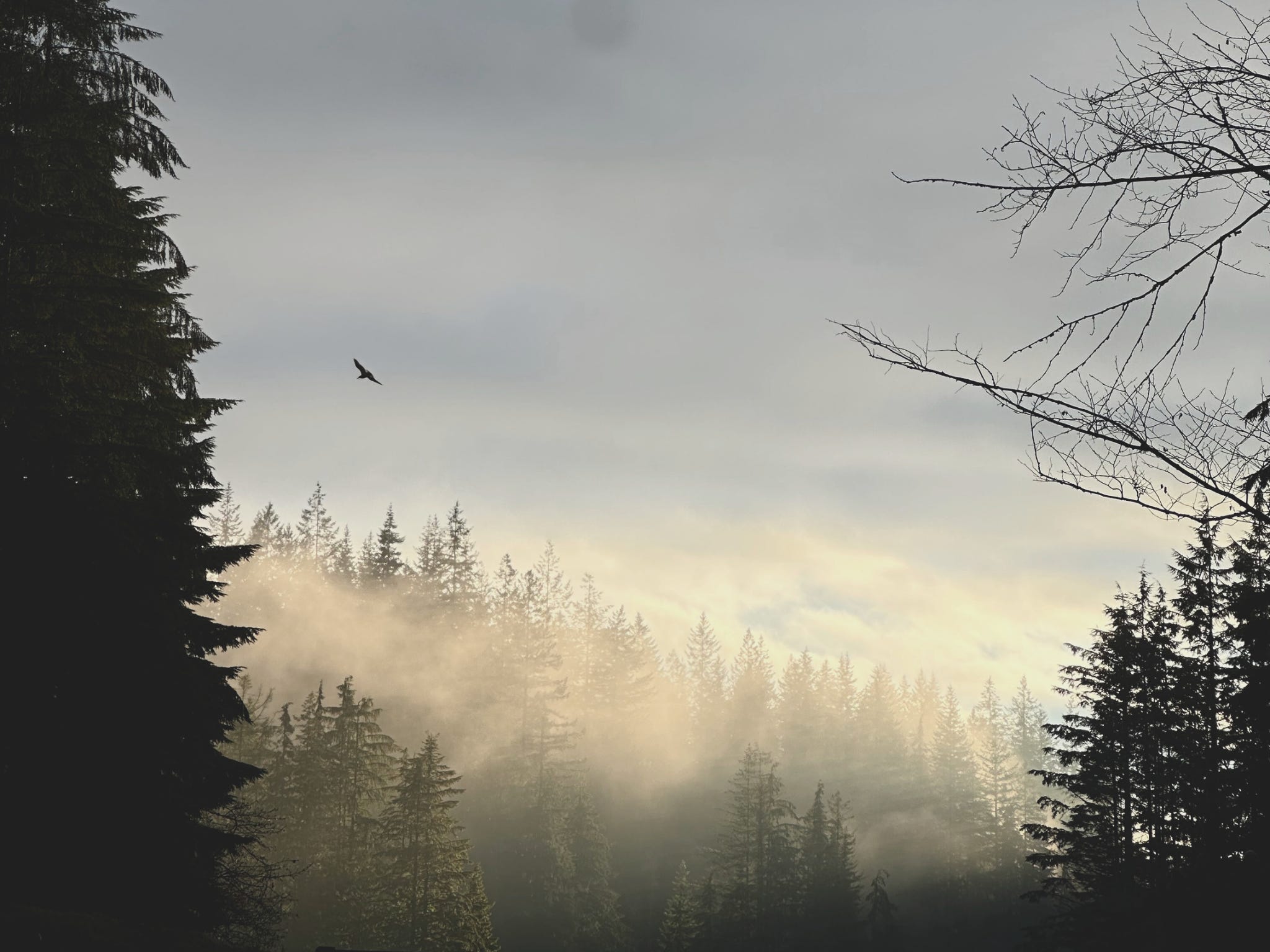
Part of my life exploding involved moving from the sanctuary of massive old-growth Hemlock trees, towering Douglas-firs and ancient western red cedars to a smattering of maples and oaks that comparatively, look like sticks and shrubs.
Every day I take a walk and struggle not to compare them. I long for what was and I yearn for what I wish to be, both at the expense of what is. These trees here will never be those trees there. And thank goodness, because maybe if all the trees were the same I’d stop noticing them, and I really love my trees.
Not everyone loves trees, and not everyone loves rain, but nearly everyone loves a sunny day. But the sun that shines perpetually gets reduced to an accustomed background that we stop noticing.
I love sunshine more after I have known the cold and dreary rain. I appreciate a sunny day because I have felt the long absence of sun against my skin intensely enough that I seek the sun when it is out.
I am less adapted to sunshine so I give more attention to my orientation inside a sunny day. I don’t just notice it more, I experience it more, I appreciate it more, and I remember it more. This attention is not forced, scheduled, or scored against a checklist as a measure of how well I am performing my well-being.
It’s an honest way I’ve been exploring how to slowly open myself up again and find what’s here that I might love. I find more all the time.
Although the trees here are not as dominating as the ones out West, they are not without their graces. Where my old giants stretch into the heavens, obstructing the sky with their clutter, these local leaf-puffed domes yield to a massive sky where restless clouds compose and dissolve across a boundless canvas.
The sky is so big and the trees are so short that I can see complete sunrises, full sunsets, and an endless configuration of clouds arranging themselves to participate, every single day. Except of course, when it rains.
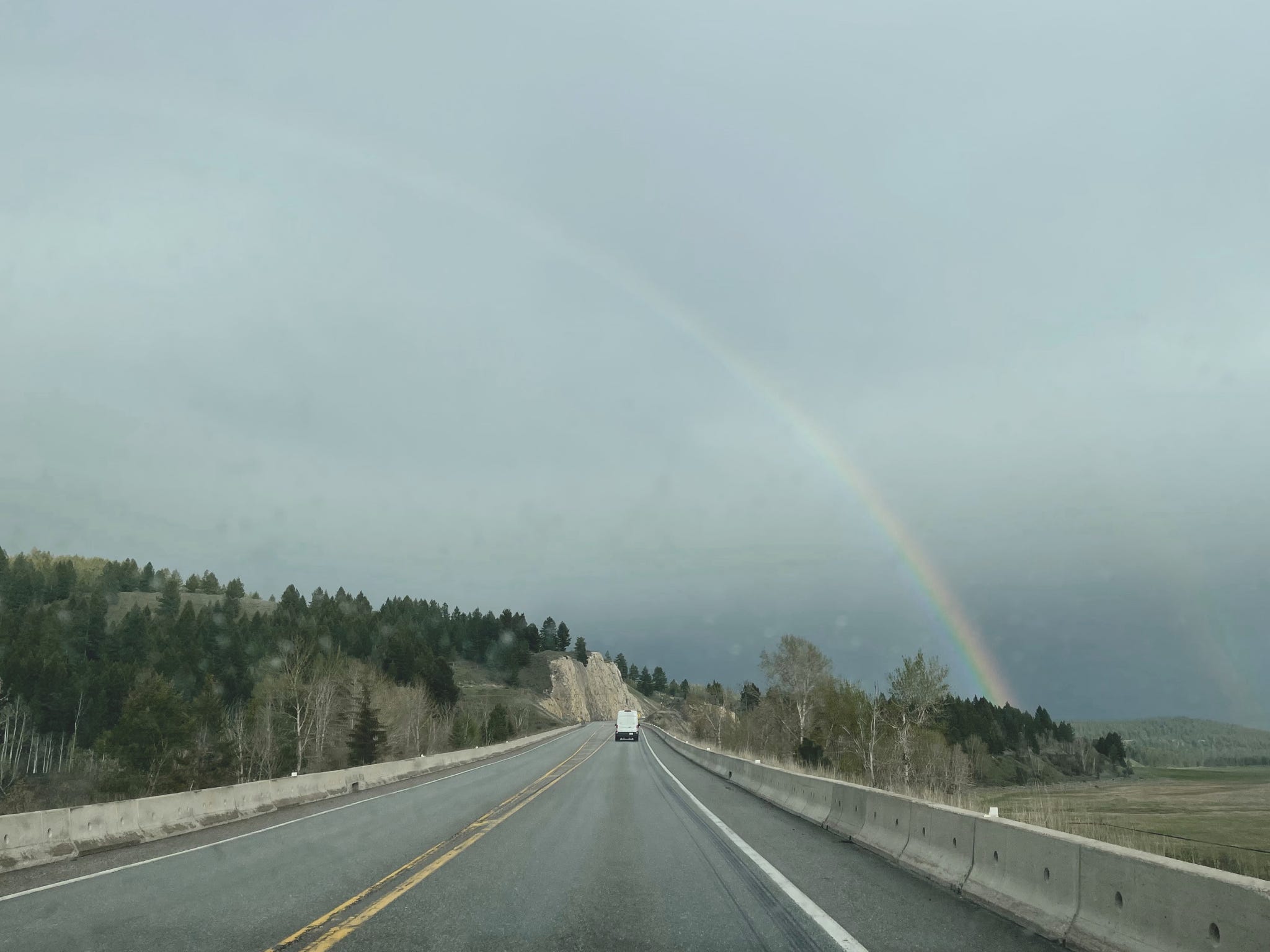
But once the rain has fallen, and its familiar fragrance still lingers on the ground, the sky does something particularly spectacular. Sometimes, with the right alignment of water, light, and a willing eye, the sky is briefly smudged by a fragment of a rainbow.
Sometimes we only notice the sky once it falls, but everything doesn’t need to collapse for us to learn to see.
I never anticipated life as it is now, but as much as I can resent the contrast, I have to admit that I am also elevated by it. The very opening that ended my old life is the same one that thrust me into the life I am in now, more finely attuned to it’s presence.
You don’t need to wait for something bad to happen to find this opening either. You only need a willing eye and the decision to orient yourself toward what’s already here, waiting for you to notice it.
🌧️ Falling in love with the small stuff, alongside you, SJT 🌈
Hello human reading this - I am a NEW writer and I want to get better at writing. If you actually read this and made it to the end ANY FEEDBACK - no matter how blunt or hard- is genuinely and truly appreciated.
I’m a professional bodybuilder so studying our weaknesses and working to make them strengths through specific criticism is my jam. I really want to improve my studying human impressions before asking the dreaded AI-bots. THANK YOU. 🙏🏻