

Eternal Easter is a series on the feasts of our lives: what we think nourishes us, what never can, and what actually does. You're welcome at this table either way, but if you want the full feast, Part One: The Hunt is where it all begins.
AN INVITATION TO PLAY
We are a society becoming increasingly optimized, but deeply unwell. Part of the problem is the hyper-focus on the individual life as it continues to move away from the community and the family core.
Another major tug away from well-being is our loss of playful exploration, of silence, and stillness, of unstructured observation.
I want to bring that back into life. I used Easter dinner as an opportunity to offer my own family an invitation to play. It went something like this…
“Humor me, will you?”
I announced to my family that before sitting down to feast, we would be playing a game. The first phase would required everyone to separate and disperse throughout the house so they were somewhere alone. They were prepared, although a little suspicious of my intentions.
I gave no instructions other than the only rules were that we could not speak and we could not be on our phones for a full five minutes.
Then I set a timer and we observed five minutes of silence, each in our own way and in our own place.
It was uncomfortable. Even for me, who knew the intention of the exercise and also knew I could, if I wanted to, reach for my peaceful centre and just be there.
The time stretched on for what felt like the longest five minutes of all time. I tried walking around a little. I pretended to observe things deeply.
It was hard not to feel the collective energy of unease with the unfamiliar. Some leaned against doorframes, walls, staircases, shifting position often. Some found partial respite watching the passing world from windows. Some tapped. Some sighed. I earnestly attempted to find meaning in a stained glass window before submitting inward to acknowledge the uncomfortable energy and my commitment to not rush to fix it or move out of it.
It was fascinating to observe how powerful the silence and stillness felt. It was unmistakable, distinguished with heavy tension and unfulfilled expectation.
A little shy of five minutes, a false alarm sounded as a timer in the kitchen ended. The relief expressed itself in audible exhales and light laughter, only to realize it wasn’t actually our release, and time still bound us to the silence.
I thought at one point my mum might lose her mind, instead of staying still, she bounced around the whole house to give all fifteen guests a hug. The restless urge is apparently inherent.
Then finally, the alarm delivered us.
We sat down for dinner and I asked if anyone felt like sharing what they noticed.
Some people thought the exercise had a specific direction that required specific answers, and launched into intricate recall, detailing where they had been.
Many recounted physical observations of the world in front of them. One person fell asleep. Another reflected upon something they saw, and felt it as a relation to something within them.
Then we ate dinner. A true feast of salad, freshly made buns, lots of butter and good wine. Prime rib, mashed potatoes, roasted carrots, sautéed vegetables, everything covered amply with ladles of rich gravy.
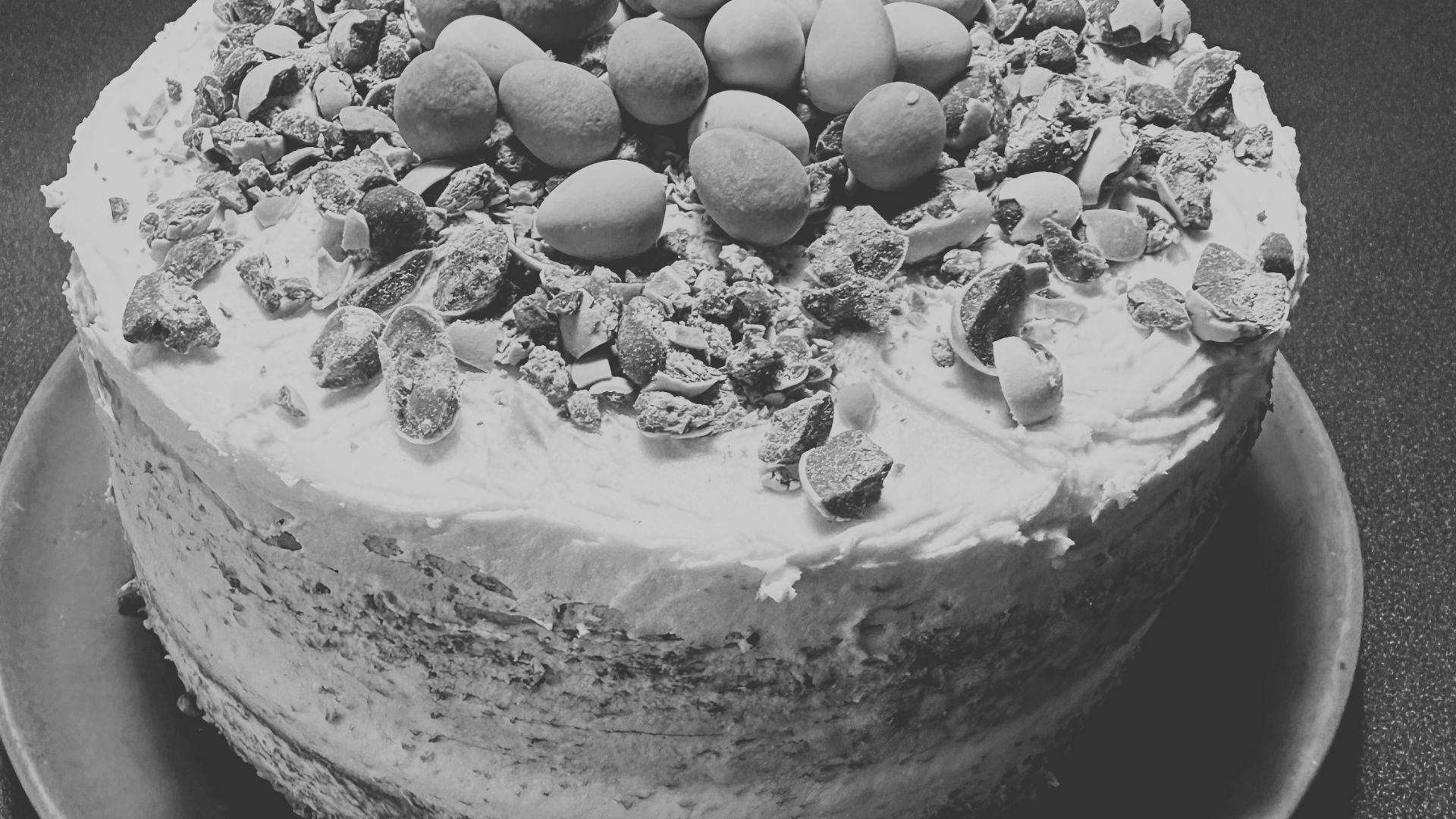
We concluded with the English Queen’s vanilla cake, layered with strawberry jam and icing, topped with mini chocolate eggs, served of course, with tea. We feasted until we were fat and greasy and far beyond full, our voices full of laughter and great stories alike.
Then, just as the imperceptible silence of the oft-avoided gap started to enter, I stood up to announce phase two.
I passed a basket around the table. Inside were riddles and questions, folded and waiting. I called the game ‘Very Bunny’, an Easter trivia competition. Whoever answered the most questions correctly would win.
Then I presented the prizes: three chocolate Easter bunnies, each a different flavour. Milk, dark, hazelnut. Because we all covet different things.
The energy shifted immediately.
The contrast with phase one was intentionally sharp. I wanted to invite people to sit in unfamiliar stillness and then offer them the known pattern of striving. Where the first act had been about quiet being-ness presence, this was a bustling shift to doing-ness presence. People perked up and leaned in as voices overlapped, ready to race to answer first.
Competition has a curious impact on people. It sharpens some and flattens others.
Some loved the chance to win, to prove, to perform. Others visibly tensed, displaying passive interest, but all attentively anticipated.
Each person was to take their turn asking a question. Each person delivered the question at their own pace and cadence, some carefully and articulately read their riddle while others loudly burst it out.
In trivia, the depth of knowledge is not measured so much as the quickness of displaying shallow knowledge. For those who can answer fast, knowledge is one currency where speed is the advantage.
“Why did the Easter Bunny cross the road?”
“To prove he wasn’t chicken!”
The first voice won. The others groaned while someone made a comment about dad jokes.
The room tightened and loosened in turns but everyone kept playing, eager to finally get their chance at success. It was much like the exact mechanics of the life most of us are already living, compressed into ten minutes at an Easter table.
When it was over, the top three were announced and I was one of them. As a competitive person myself, who built a lot of success in the pursuit of achievement, this wasn’t much of a surprise to anyone.
In sequence, we selected our bunnies. I chose mine, dark chocolate, the best quality chocolate of course, and purposely made an immediate demonstration of unwrapping it as quickly as possible.
“I wonder what’s inside.”
I was secretly trying to condition people in the same way that society conditions us with other illusions of expectation. All eyes were on me, curious and quizzical alike.
The foil came off in strips. I snapped its head off in front of everyone, dramatic, performative, as if I was so eager to see the prize I’d won, to find what was waiting inside.
I held the two halves in my hands and looked questioningly at each.
I gasped then paused long enough for the table to notice the pause.
Then I held them up with an expression of utter dismay with the hollow cavity facing out.
“It’s empty!” I wailed in disappointment.
The room exhaled into laughter. Relief, mostly that I hadn’t lost my mind over something so childish as a toy inside an Easter egg.
I broke the bunny into pieces and passed it around to share so anyone who wanted chocolate could have some. The prize wasn’t mine to hoard, it was hollow anyway.
Then I pulled out my notebook and cleared my throat for the last time.
“Now if you’ll please allow me a philosophical indulgence.”
I began reading my personal notes aloud, then passed the notebook around the table and asked each person to read a section until it came back to me.
Some people were enthusiastic and contemplative.. Some people tolerated it while secretly rolling their eyes behind their head. Both are normal human responses. The point wasn’t agreement. It was just the invitation to play.
A SEAT OF ONE’S OWN
The most remarkable thing about the human brain is that it produces a personal representation of reality, not reality itself. For all our efforts, we can share a meal, a game, an experience with others but we cannot fully share our reality with them.
Fifteen people sat at that table. Fifteen different Easters happening at once.
Those who couldn’t sit still during the silence and those who appreciated the quiet of it. Those who loved the competition, those who didn’t, and those who seemed indifferent to it.
All of us seeking and perceiving different things, enjoying or avoiding different elements, foods even, literally nourished, emotionally satiated to varying degrees, or left hungry by the very same feast.
This was a different Easter for everyone in our family as we were all feeling the absence of my grandad in our own way. I designed the game as a reflection to share in a playful manner one of the biggest silent lessons my observation of him taught me.
THE CONTRAST OF LIFE
The traditional Easter egg hunt teaches us to narrow our vision and look for one valuable thing: CHOCOLATE. Even if you don’t like chocolate, everyone participates in the hunt, often ruthlessly trying to get more than everyone else.
The hunt mimics real life in many ways. How many of us walk through life this way: preoccupied from presence, with our attention narrowed to what has been pre-labelled as worth finding.
The first silent space offered the opposite. It was designed to be a contrast to the steady rhythm of pursuing the next thing to find. It was simply a moment to notice.
And since we are so conditioned to pay attention to what we think matters, everyone noticed something specific and unique to them.
Life works this way too. You must make it your own.
The bunnies were hollow on purpose as a mirror of how easily we get wound up in the pursuit and attainment of the things we believe we desire. Sometimes, our beliefs get shattered. We convince ourselves that gaining the next thing will offer a particular sense of fulfillment, but it never does.
We expect things to be better than they are and spend most of our lives contrasting fantasy to reality and wondering why we are restless, dissatisfied, and so uncomfortable with the stillness and the silence.
The bunnies were hollow to remind people to seek what you actually want. And a caution of the deflation and disappointment in chasing what other’s deem worthy. There are far too many people living a performance of someone else’s life instead of authentically experiencing their own. You master the role at the expense of the self.
It’s not that chasing goals is wrong or bad, in fact, that is part of what makes life so rich and interesting. But as much as it is important to chase goals that are personally meaningful, it’s also an invitation to enjoy attainting them as much as pursuing them. It’s one thing to get to the top of the mountain and really appreciate the view, and quite another to only be able to see all the other mountains still yet to climb.
When you get there, enjoy it fast if that’s your style or savor it slowly. Keep it for yourself or share it as much as you can. But anyway you do it, know that you can’t live there, it’s not where you find fulfillment.
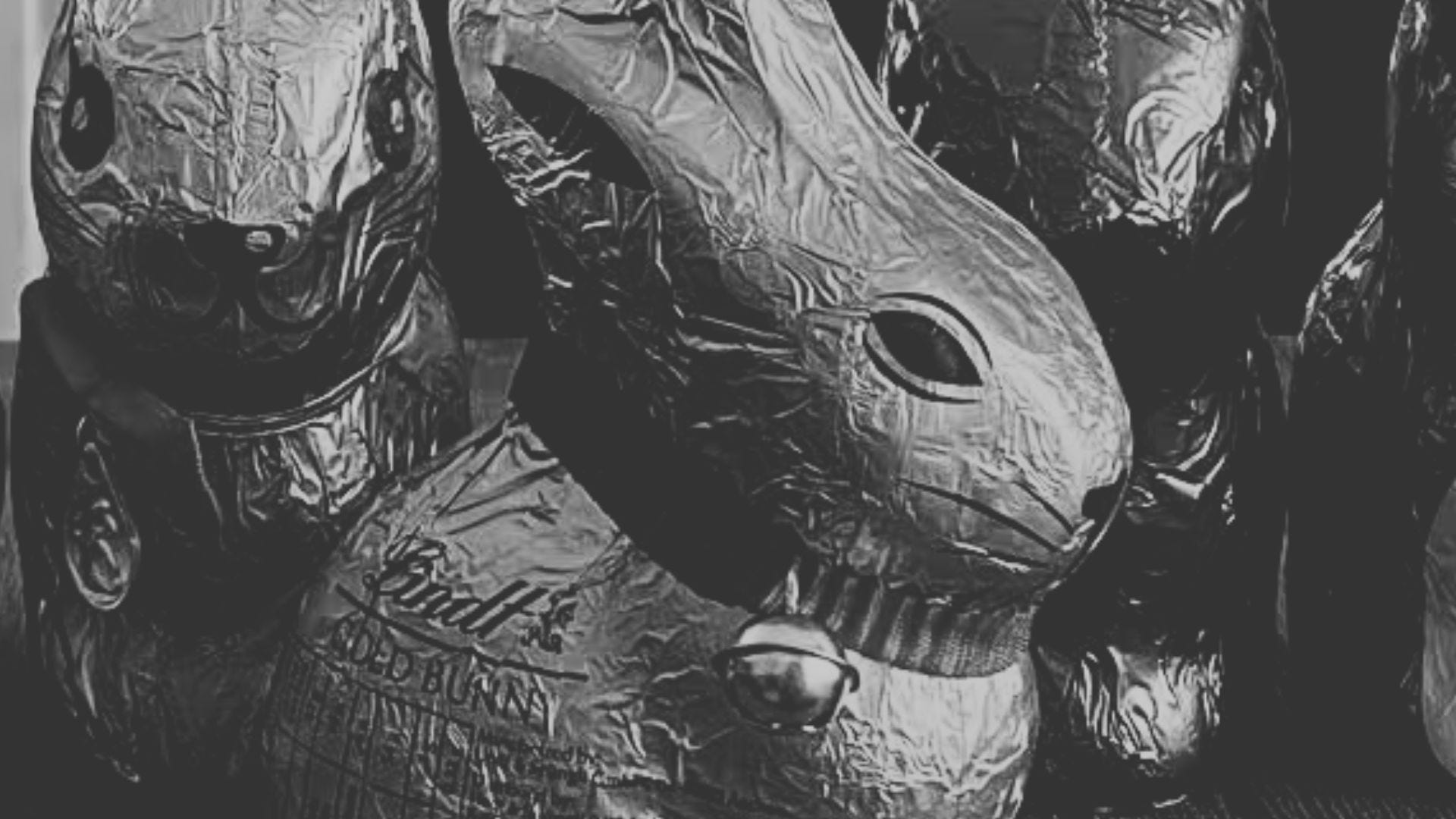
There is no nourishing feast inside the bunny.
How many of us spend our lives fighting for a seat at tables where we don’t belong? Performing, competing, earning approval, trying to squeeze ourselves into the shape of someone else’s expectations. We think belonging means fitting in, being accepted or chosen and therefore, deemed worthy enough to stay.
But the table you actually belong at doesn’t require you to earn your seat. A good table is only complete because of the particular way you bring yourself to it. Your quirks, your preferences, the parts that don’t quite fit anywhere else are precisely what make your seat yours. A good table holds all of it and has a seat for everyone.
Easter is a moveable feast. It does not fall on the same date every year. It cannot be summoned or forced into arrival. It happens when certain conditions align, two incommensurable rhythms of solar and lunar, meeting at the right moment.
Easter is the paradox of life.
It is the striving and surrender.
It is the seeking and stillness.
If you walk in the right direction holding both openness and intention, the feast will find you.
Grief, love, joy, loss, the people at your table — they all return on their own cycles, in different forms, when the conditions are right. You cannot force them or will them to arrive on time, or even in a certain way. You can only prepare for them, attend to them, and receive them when they come.
It’s easy to mistake busyness with productivity. But the hardest work is not the hunt as the hunt is much a demonstration of skill, the depth to which you can play.
The part most of us struggle with is the preparation. We want to skip the gap. We try to avoid surrendering into the simplicity of being. We overburden ourselves with doing only to put off practicing peace as a skill. The pause is where we learn to cultivate such peace in the days between feasts so that when the feast arrives, we are ready to be nourished by it.
Time is not linear. It spirals outward, circling back upon recurring experiences, each enriched with their particular angle of novelty from the slight ways we’ve digested new understanding of the world, and ourselves.
The sacred cannot be summoned, but you can prepare to receive it as deeply as you are open to witness it.
When it arrives, the depth of your perception may nourish you, not just for a day but for the rest of your life.This is the art of making memories to nurture an enriching life.
Hemingway knew this in his reminiscent recollection of his time in as a young writer in Paris, fondly referring to it as “A Moveable Feast,” the title of his last book.
A moveable feast is more than a memory, it is the thing you carry forward because you participated in letting it in. You weren’t rushing to the next thing or racing your mind somewhere else, you were present enough to be in it.
You cannot carry Paris with you unless you have known the wait of its absence.
The days between feasts are not empty and meaningless, or trivial obstacles to rush through. They are the preparation. The hunger that makes the feast a feast.
Real life happens in between the milestone moments that mark our lives. The highs and the lows define the structure, but the time in between gives the gradient and texture. The overall feeling of your life is in the everyday and how deeply you choose to be with it.
Between it all — the hunting, the feasting, the competing, the playing, the winning, the losing — the greatest luxury in life is time and presence with the people we share it with.
Easter will come again. It always does. The table will fill, some seats will empty, some new ones might appear, too. It’s breathing and alive, just like life.
The bunnies will be hollow, but every now and then, a surprise might appear. The stillness and silence will patiently wait for us to remember it, notice it, enjoy it or not.. And somewhere, in the gap between feasts, we will all prepare ourselves —in our own way, intentionally or not — to receive what we’ve been seeking all along. A life of one’s own making.
You can fill your basket with chocolate eggs or the presence of searching for them. My suggestion is both.
Still seeking while learning to sit in the silence alongside you, SJT