

Eternal Easter is a series on the feasts of our lives: what we think nourishes us, what never can, and what actually does. If you're just joining, Part One: The Hunt is a good place to start.
A MOVEABLE FEAST
Spring is my favorite season because it rolls in as storm clouds over dead, frost-bitten land and from this barren nothingness, has the audacity to deliver snowbells and daffodils. She finds us thin and despairing from winter’s dregs, but seduces us with timid warmth and wavering rays among speckled rainclouds. Yes, spring is the everything season. Everything happens in spring. Buds begin to bloom and beauty of every kind bursts to announce her commanding arrival, offering us life, refreshed and renewed. And always somewhere in spring, we celebrate the gift of salvation itself, through Easter.
Easter can be celebrated anytime between March 22 and April 25. Among snow squalls and cherry blossoms, the holiday can fall on 35 possible dates, some of which do not recur for centuries. This curious anomaly is the result of two incommensurable rhythms, solar and lunar, that never quite resolve. As the celestial bodies above us weave in and out of sync, our own inner world mingles in similar flux. It’s most strongly felt in the bittersweet opening where heavy spells of grief finally yield to the gentle invitation of gratitude, and the grace of good times, once more.
Easter falls on the first Sunday after the first full moon following the spring equinox. The solar year and the lunar month refuse to divide cleanly into each other, so the Church invented an ecclesiastical moon— a mathematical phantom that approximates the real one to allow for uniformity. This strange solution becomes more beautiful considering it is an imperfect representation that is not always accurate to the actual lunar light, yet we collectively navigate ourselves toward it. In a poetic but universal way, we are all self-orienting toward an assumed light we trust rather than a perfect light we cannot see.
This makes Easter a moveable feast. One that drifts, returns, reappears on its own terms, in its own time, when the conditions align. It’s a remarkable passage that we carry without question; we need no particular intensity of faith to know that it will happen again this year as it did last, but markedly, always, a little different than Easters past. Yet when this same faith is asked of us in the face of loss, pain, suffering, our trust falters and we instead insist our deliverance to be on schedule. We have no patience for the careful alignment of life’s next blessing. We want to skip ahead, rushing back into our joys and jubilations at whim, without the forbearance to savor the unique coordination of each feasting moment in its own delicious, particular quality.
We think time is linear, but much like our ecclesiastical moon, it too, is a construct of a different kind. We refer to time in numbers assigned to seconds, minutes, hours, but we relate to it much differently. When you are with someone you love, or engaged in an interesting project, or pressing attention narrowly toward a deadline— time rushes, compressing and disappearing seamlessly. When you are immersed into the new and novel, or eagerly anticipating news, or suddenly caught frozen in grief, surprise, or loss— time stretches, expanding, it seems, to near eternity. We know time as numbers that convey positioning, but we feel time as a varying intensity of experience.
Time is not a straight line. It is more like interlocking circles, infinite forms in recurring collision. That which is sacred is not punctual, but instead arrives perfectly on time for when it is designed. It cannot be summoned, but it can be calculated, watched for, prepared for. The sacred happens when conditions align, partly by luck, partly by preparation, partly by the ancient, approximate mathematics of a life attended to. And when it arrives, if you are ready to receive it fully, it nourishes not just for a day but for the rest of your life.
How does one get to such a state of readiness? You must first admit that you are hungry. Not just in a physical sense but in an existential one. You must be hungry for the truth.
The truth is also not punctual. But like our ecclesiastical moon and time itself, it keeps its appointments.
THE GAP
The truth finds all of us, eventually. Those of us who reject and resist it the most are the very same who need to be liberated by it most deeply.
But between the truth and our freedom, there is a gap.
On the other side of that gap is peace. Not the fuzzy kumbaya kind you think you can buy as a pill, luxury item or otherwise, nor the kind you think you can learn from a guru, an enlightened expert or even a well-posed prophet. The kind that only comes from being in your gap and staying there long enough to learn what it has to teach you.
On the other side of that gap is a kind of peace that only you can give to yourself. No one can give it to you the same way no one can take it from you. You can access it any time, should you choose to, and once you have it, you will carry it with you, always. But you have to find it first.
I can tell you a bit about my gap, and although ours might feel similar, it won’t be quite your own.
My gap felt like chaos when I first found it. I claimed I wanted peace, but I was living for chaos.
Somewhere in the middle of another breakdown, a haunting truth crept across my consciousness like an unwelcome shadow: the common denominator was me.
In all of it, no matter how carefully or earnestly I positioned myself as the receiver of chaos, the victim of it, I was also the very centre of it, every time. Why would I do this to myself? I desperately pondered, trying to pinpoint the onus of blame outside myself before settling where most people get stuck: my parents, of course it was their fault.
An echo of my psychology and neuroscience education reminded me of a particular phenomenon in the developing brain that learns to mark chaos as ‘safe’ simply because it’s familiar. The pattern-hungry brain prefers predictability, even painful predictability, more easily registering safety in known chaos than accepting it in an unfamiliar calm.
Every now and then, a new or unexpected force ruptures the practiced pattern and the brain, despite itself, cannot unsee it. When facing undeniable truth, reality fractures, shattering even the most foundational illusions, as the brain, through all discomfort and resistance, irreversibly adapts. Once the brain expands, it cannot go back to old form. The truth that comes to light cannot be re-called into the darkness of ignorance.
It’s not your fault, but it is your responsibility. Chaos was a responsibility I neither wanted nor felt capable of claiming. And yet, that one choice to claim it radically changed my life.
Most of us didn’t realize we grew up inside chaos until after we had survived it. Chaos wasn’t an event, it was the every day.
An unstable and inconsistent childhood became the mirror for my adult life. Everything felt like friction. Even when things were good, a destructive force (usually me) had to find the thread of what was wrong and pull it until it became full-blown wreckage.
Awareness of this propensity to never be satisfied, happy or ‘chill’ became a repeating theme in therapy after another win, another accomplishment, and still, I was unfulfilled and empty. It is the reason I did such intensive work leading up to our wedding, because I didn’t want my mind to ruin the big day the way it ruined everything else. It’s also what led me West— to the land of great adventure, where the predictable course of chaos met its match with the unpredictable landscape of limitless heart-thumping drama.
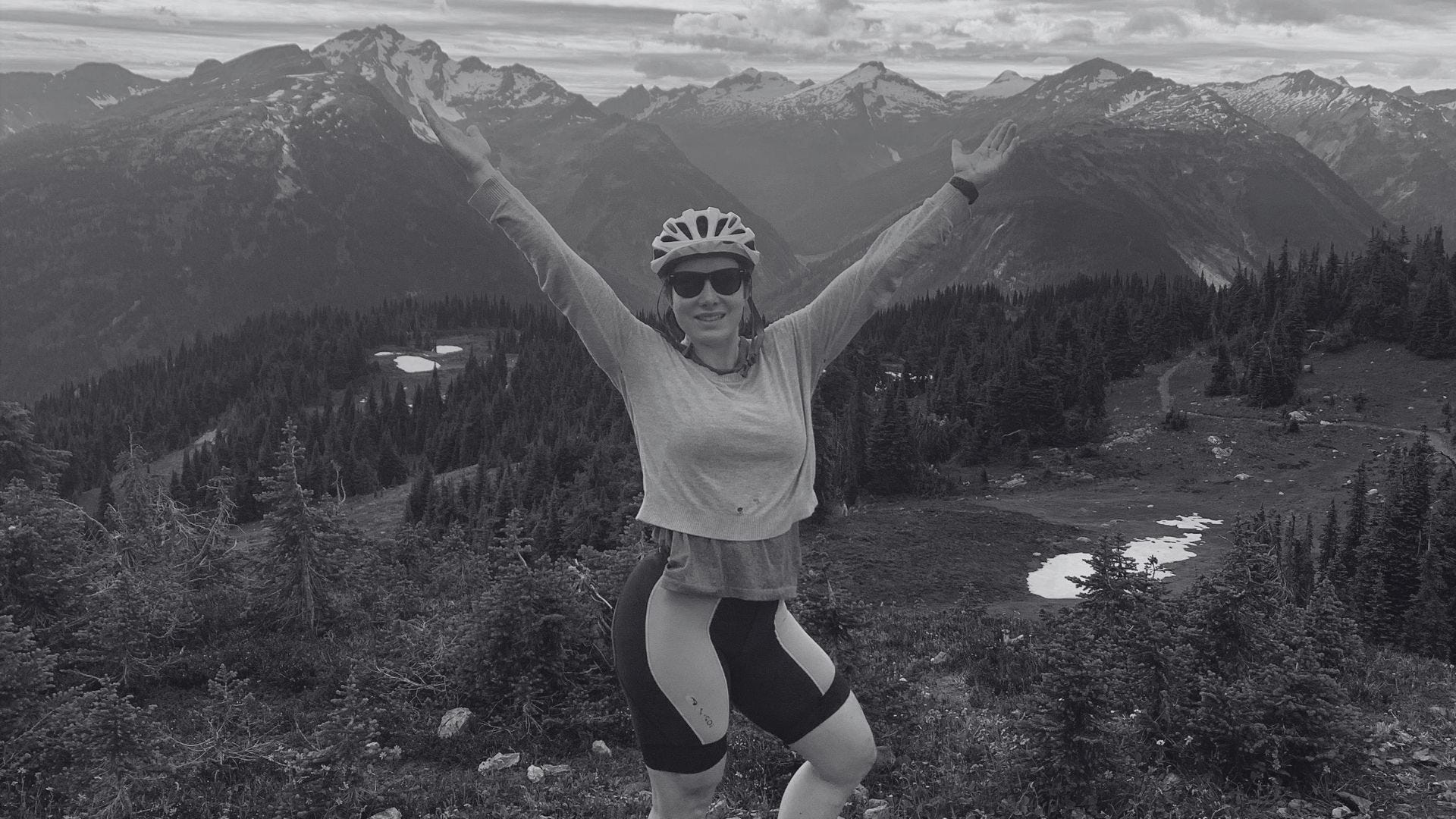
The first time I hit flow state was hurtling down the legendary Frisby Ridge, an advanced mountain biking trail in Revelstoke, BC. The sun was setting, I was getting goosebumps on sweat-stained skin and the ‘grizzly bears in area’ warning sign from the ascent spiked a nervous but thrilling urgency to descend quickly, but in one piece.
We had just struggled up 12 km of gnarly roots, bulging rocks, tight twists and sharp turns under the thick enclosure of dense forest to burst into open altitude of the mountain crest— but now, time was critical, requiring a swiftness that exceeded my ability. We began our descent and I quickly lost sight of my husband after a series of abrupt starts and stops that sent me squealing with terror at the steepness and speed. The dim light encroached from descending back into the dank forest and I knew I had no other choice but to surrender my fear and trust my skill.
Our biggest growth comes from meeting our biggest gaps, not secure with the skill to manage them, but precisely without it. Armed only with the faith that we are capable of figuring it out, we must rise to meet the demand.
So I went for it, and at some point, my hyper fixation on coordinating my limbs in reaction to the unpredictable terrain in front of me gave way to something I can only describe as complete joy. Time ceased to exist, much like my separation from the mountain itself, and the action formed through and of me without effort or resistance.
I remember witnessing a rare stillness and expansive focus where the world faded yet was also incredibly rich in detail. My senses were heightened to the extreme, but instead of pressure, I felt wholeness with the moment. I can’t tell you how long it lasted, only that by the time I noticed this peculiar yet tantalizing sensation, I was a good ways down the trail and rounding off the final stretch with hoots of laughter and apparently, newfound riding skill. All the tension I carried before gave way to ease and a sense of embodiment that I’ve tried to carry with me into other feats of partially reckless, always ambitious experiences.
I touched it again riding alpine edges in deep powder at Whistler. I held it high over my head and felt it in every trembling muscle winning the overall title at my first self-coached bodybuilding show. I was undone by it paddling the wild ocean waves beside behemoth humpback whales. I was carried by it in the ecstasy of our wedding day. Each one an uncanny reaching for the adrenaline-inducing familiarity of chaos, this time in a consciously chosen territory. Once the glow of each feast faded, one after another, I found myself returning to the residue of restlessness and discontent again. I was so eager to find fulfillment but everywhere I looked, no matter how monumental or challenging the experience, only a hollow centre reflected back, with nothing I could hold.
I was still hungry, but I was no longer sure what I was hungry for. The heart-pumping adrenaline had mixed with something new: awe, wonder, inspiration, love. The natural world opened something inward. The expansion could not be contained. And slowly, my appetite for thrill, achievement, and excitement ceased to satisfy.
I knew I needed something other than chaos, but I oscillated around peace for a long time before pursuing it. Peace sounds boring to those who were forged in chaos — at least that was the lie I told myself. But it was too late, undeniable truth had fractured reality and the old pattern could not hold.
Every time I found myself in deeply pleasant moments where the rush of aliveness mingled with something else that came more slowly, I leaned toward it a little further. The more I learned to relax, the more receptive I became to all that I had been missing by filtering the world through the tight lens of survival.
I began to notice how the easy unfolding of small things made me feel good, even when I thought I was feeling bad. Simple pleasures like wet grass under my feet, sunshine on my skin, a long exhale that loosens the shoulders, floating in salt water, new socks, melting really good chocolate on my tongue— life started to offer me little rewards, winks of my receptivity, in the inconspicuous every day.
Here, I found peace.
Some people think this comes with age but I know too many people of advanced years who die without having ever known it. This sounds sad, and it is, but it’s also good news, because it means it’s not something you have to wait for but something you can earn, curate, practice, and learn.
Peace is a skill.
But the world we live in is structured away from that skill. Most people spend around seven hours a day on screens, which adds up to over 100 days a year, a full quarter of their lives, consuming a world they are not actually living in.
The phone is not designed for peace. It is designed to feed our addiction to chaos.
I always knew I didn’t want to live in chaos, but the familiarity of stress hormones felt like an addiction too hard to overcome. I didn’t quit stress, I shifted my relationship to it.
I didn’t try to dissolve or deny my natural tendencies — some of my best memories and greatest achievements came from the storms of chaos. But I did change how I saw myself in relation to stress. I was no longer willing to play the part of helpless puppet once I realized it was actually me who was in charge. But before I could claim this, I had to separate myself from stress as a personality and find my control centre.
Like many who seek a peaceful centre, the first place I looked was meditation.
I had built a decent padding of pride through my ability to adapt and gain new skills quickly in chaos, so my slow and clumsy search for peace was a frustrating venture, and one I almost quit many times.
Transcendental, loving-kindness, body scan, visualization, vipassana, zen, in therapy, with breathwork— I tried it all, to no avail.
Time marched on ambivalently and although my awareness of my addiction to stress and my intention to reorient were evident, I found myself no closer to peace than I was separate from chaos. I grew weary and uninspired, always sitting down and settling into the same circus routine of getting carried away on a torrent of aimless thought, drifting further, it seemed, from the peaceful centre I sought.
But it wasn’t until I was stranded at an airport in the middle of the prairies that I finally found it.
Maybe you know this feeling, too. Where you have decided who you are no longer willing to be, but you’re not yet sure of who you will become, and less so, how.
Sometimes life has a curious way of delivering us exactly what we need when we least expect it. That is, of course, if we let it. Sometimes life tries to whisper encouragement that is too easy to ignore. Sometimes life needs to speak peace to us by using the only voice we know, chaos.
It doesn’t matter if your own world is whispering or shouting, but only that you trust that the path you’re being shown is the one that will take you where you want to go. And right now, I most want to go to bed. As luck would have it, life agrees.
Part three illuminates the delicate art of surrender, but now, surrender instead to sweet dreams.
𓆸 Curating calm against all instinct, SJT