

We all think we want options. We believe that more choice means more access, more success, more status — that getting more, at last, will fill the lack caused by whatever core wound we're chasing. Love. Acceptance. The thing underneath the thing.
But if that were true, I’d be rejoicing instead of cursing every time I turn down the condiments aisle (yes, a whole section dedicated to sauce, since the food itself is not enough, much like you and I). Instead, I am confronted with 200 choices about which ketchup is ‘best.’
We equate having more options with more abundance, more importance, and more freedom, but this is a mistake.
We think variety is the ‘spice of life,’ but in fact, the true best way to make anything taste better is not to add more to what already is. It’s to go without.
Hunger is the spice of life.
To know its absence long enough to appreciate its presence, where the longer we have been without, the more deeply we are capable of celebrating the simplicity of what it is.
No longer caught in the illusion of what it could be, untethered from the fixation that it needs to be something more like that over there, we are enraptured by the honesty of what it is, as if it were the first time we’ve come to know it.
And so we come to appreciate it more. But the more value we give to what we already have, the less predictable and controllable we are — and the world hates that.
So we consume and we yearn and we strive for more more more. Never reaching the elusive utopia of contentment; holding our happiness at an eternal distance of almost, if we could only just get a little bit more.
“Don’t it always seem to go
That you don’t know what you’ve got ‘til it’s gone…”Joni Mitchell croons in her famous song, Big Yellow Taxi.
The beauty is in the simplicity we failed to notice while we had it that we can only observe once it’s gone.
Ask anyone who’s lost someone they love and they’ll be the first to tell you that in almost any context, no matter how painful or limited, what they wouldn’t give for one more day with the person they love again.
“A healthy person has a thousand wishes, but a sick person has only one.”
We overcomplicate things because we can. We under-appreciate what we have because we can sense, sometimes even see, that we could have more.
We are so eager to force our way out of the innocence of youth, unlocking bigger achievements, new levels, more responsibilities — and for many, we confuse this as meaning, wearing our busyness, awards, and increasing obligations as a badge of status and importance that symbolizes our worth.
We inflate ourselves with illusions of credibility and with stories of special intrinsic value that we have accumulated so much, but yet, we always want more.
Indeed, we even create complex justifications for more simply to sustain everything and everyone we’ve thus acquired.
We create entire worlds around the fallacy of absolute dependence on us, raising ourselves to increasingly higher standards and distinguishing ourselves with elaborate pedestals of self-importance.
Paradoxically, we put ourselves in our own cages by conditioning our ecosystem and our self alike to always perform at a certain level, capacity, and rate of expansion; confusing our pride with purpose.
If all this — status, money, responsibility, achievement — were truly a reflection of our worth, why would we need to keep collecting it? If it were all taken away in an instant, what would be left and could that alone sustain everything that we’ve collected? Could it even sustain only us?
And what is the measure of success anyway if we only use it to build a shell that projects a mirage of a fabulous life, but we can neither step into it or be satisfied with it?
There is no lack of pretty paintings of lives that are entirely absent in spirit and void of emotional presence.
I’ve written about this in a series called Eternal Easter, on the feasts of our lives: what we think nourishes us, what never can, and what actually does. The premise is simple: the quality of our attention determines the depth of our appreciation. The more open we are to the ordinary day, the more we can enjoy what already is.
“Enough is a feast.”
This deceptively simple teaching by the Buddha cuts straight against the modern instinct to keep optimizing, accumulating, upgrading, striving for more.
What is enough, and when will we know?
Few of us have ever defined it for ourselves — and our culture would prefer that we didn’t. It constructs our existence inside containers of fear, scarcity, threat, and lack, whether they are physically or emotionally true or not.
A society that is scared and sick and separated is a very profitable one.
If we never pause to take inventory of what is, we will forever be living in the gap of lack by comparing it to a past that no longer exists or a future that never does. We will always need more.
The trap of more is two-fold. Even once you arrive —you get there, you attain it, you have enough, society changes.
It’s one thing to get to the top of the mountain and really appreciate the view, and quite another to only be able to see all the other mountains still yet to climb.
Even among those capable of appreciating the top, eventually, everything changes.
Society shifts, what was considered good is now bad, the goalpost moves — usually right as we approach it — and suddenly, what you have and where you are is once again, no longer enough.
Whether it’s an evolutionary byproduct or a marketing design matters less than how pervasively true it is.
Falling behind once meant banishment, and banishment meant death — and though the stakes now are only psychological, we still treat them as fatal. The slow torture of watching what you cannot touch is as corrosive to the soul as any poison was to the ancestral body.
The hedonic treadmill of More and Better brought us to a point of luxury our ancestors could not have dreamed of. And yet we are living in the most abundant time in human existence while people struggle with their physical and mental health more than ever. Maybe the lived reality of keeping up with modern culture is collapsing increasingly more bodies and minds into despair. And maybe this is also the first time we’ve ever had such a luxury.
Even when things are going well, we have a particular proclivity to make it hard for ourselves. Our values change, the dynamic reorganizes, we invent entirely new metrics and standards that depreciate the value of all our other qualities and assets, so we begin the climb again.
We like difficulty because it gives us something to pursue, a problem to solve, fix, and eventually, overcome. We leaned into dopamine-dominant behaviors that rewarded the excitement of seeking. Our modern world not only offers new novelty at every turn, but it also compresses time, nearly obliterating the space between action and attainment. We are a species wired for more and seduced by the belief that it’s not enough.
Paradoxically, the chase offers enough reward to keep chasing. The allure of enough leads us to overextend and expose ourselves to too many things, increasing our vulnerability, threatening our sense of security, and convincing us the solution is found in “just a little more.”
We entangle ourselves in increasingly complex webs that eventually become liabilities, some of which we now require to maintain our image of enoughness, fewer to sincerely improve or amplify it. All the while convincing ourselves that it’s all a representation of our worth.
A more accurate measure of worth is realized through knowing what is worthy to us, personally.
But where do we find that in the myriad of conditioning and noise where most people would not recognize the sound of their own voice if it were the only one with them in the room?
To be capable of rejecting ideas, turning away opportunities, releasing desires, letting go of what seems really good from the outside, and what sometimes even feels good but no longer right, is no easy business.
Not only do we come to love places, people, ideas, businesses, objects, jobs, even fragments of our personalities — we also come to identify with them. Changing our mind feels like a threat to who we are. That fear holds some people in place, caged by fear. For others, it's the doorway to pursue something more real now. Now is the key word.
Who you are is not who you’ve always been, nor is it who you will always be. And thank goodness — it is, after all, in your nature to become. Not more. Just other than you were.
Yet it is very hard to navigate the ambiguous territory of Where To Run Next (so I wrote about it) without feeling confident in the place we will launch from. For setting down a path clouded in the uncertainty of the path itself while carrying uncertainty about yourself is nearly the most certain way to ensure that you do not set out at all.
The only belief that matters: that you’re capable of figuring it out.
But feeling confident in our ability to find our way usually rests on a quieter foundation — an earlier acceptance of what was true for us, and what was not.
We know more about the truth of who we are by knowing with certainty, who we are not.
Everything we know about ourselves, we know from the unconscious or deliberate construction of what the world showed us. We internalized those inputs and organized them into what we call an identity, a self, a lens of perception that now colors everything we perceive, and much that we don’t.
When a person undergoes radical transformation, they are often surprised to see, seemingly for the first time, what was always there. So powerful are the constructs of perception.
And still we learn more about ourselves from failure than from a life that only moves in a steady sequence of confirmed successes. Stepping outside the boundaries of who we think we are, daring to experiment a little, trying, asking, succeeding sometimes only to decide it’s not really the right feeling.
This is the inception of more.
And from a sincere desire to find something authentic, we adapted to provide more options, more access, more variety to discover what is really our own. What started as an innocent pursuit to discover how to discern the true self from the performative one morphed into a limitless smorgasbord of possibility.
Variety is good.
We need to have options. Monopolies are dangerous, not just for distribution of power and control, but also for survival. Think the vulnerability of mono-crops, the necessity of genetic variance, and the benefits of idea-sharing. A melting pot has more advantages than drawbacks because when one system dominates, everyone loses in the long run.
Humans are the same.
We are not meant to exist in a silo but go off, get out, and seek as we explore our identity. Ancient cultures used to practice sacred ceremonies for rights-of-passage, often marking the transition from childhood to adulthood, that were characterized by controlled identity disruption followed by structured integration.
We still practice the identity disruption but we’ve outsourced the control and we have discarded the integration entirely.
Marketing and the instantaneous nature of modern culture hijacked the way we establish ourselves. Advertising funneled everyone through the same hallway of manufactured desires, encouraging us to chase the same things. It was important messaging that we be en vogue, on trend, with the times, so as not to get left behind.
Suddenly, our appearance and the commodities that supported our image became the primary signals for power, status, belonging, worth. Consumerism culture became the signal of self, creating characters that sustained entire industries such as the luxury goods market, to maintain their illusion.
For instance, we want new clothing. We wanted it because we saw someone in our community with it in real life. Then we wanted it because we saw it on a billboard or television. Then we wanted it because it was on an influencer or ad somewhere on the internet. And all the while, the gap between wanting and having collapsed.
What happens when we shorten the distance between desire and acquisition so far that as we think, so we have?
When we erase the necessity of doing a thing, we lose the capacity to do it.
And to many, that sounds awesome. We do not want to commute, we do not want to clean or get groceries, or input data onto spreadsheets — we are not only willing, but excited to outsource the menial and meaningless. Yes, we are deeply committed to this opportunity to pursue meaningful work, deeper purpose, and higher ways of living. So a few skills get atrophied along the way, what does it matter?
AI and the internet can show us answers, but not understanding. If we don’t think through things ourselves by struggling with them, applying them, testing them, they don’t stick. Information is not knowledge. Thinking is the practiced skill that turns it into one.
“If you are lucky enough to have lived in Paris as a young man, then wherever you go for the rest of your life, it stays with you, for Paris is a moveable feast.” — Hemingway, from A Moveable Feast
You cannot carry Paris with you unless you were present enough to let it in.
Western culture told us that we can do anything, that we were in the land of opportunity. As a by-product, we really thought that we really could do anything, and assumed that because we could, we should.
You are special.
You are unique.
You matter in a very important way.
And it’s all true and it’s all possible, but they forgot to share the most important part: it’s impossible to define what’s not there. Light only exists in darkness. The contrast of what isn’t gives rise to what is. You’ll be a surface copy of nothing in particular until you go deep on a few things, which means rejecting a lot.
The first time I remember the crushing feeling of anxiety was in grade 4. I was ten years old and I was filled with so much potential. I tend to land somewhere beyond average with nearly everything I do. In school, that seems like everything that matters in the entire world. Every subject I was better than most, and where I really applied myself, which was everywhere by the way, I was The Best.
“You have so much potential,” the adults would coo in wonder. I know it was well-intentioned but it also led me to pull out all my hair until I had a bald patch and my skull was swollen.
If I had so much potential, then surely there was a huge responsibility to fulfill this potential. Clearly the only way that I could ever attain success, which was of course, the key to belonging and love, then I had nothing more to do than solve world hunger, end all wars, cure cancer, and win an Olympic gold medal while earning a star on Hollywood Boulevard.
Just because you can, doesn’t mean you should. Some dreams are better after they die. Most of the time, the dreams that become reality are only enjoyable because of the awareness of all the dreams that had to be sacrificed in order for them to exist.
Dreams require sacrifice. Sacrifice requires discernment. Without it, the wrong dreams are chased, the wrong sacrifices made, and the wrong reality is created.
How can we know what’s wrong?
Our ancestors used to eat things and literally die. This did not have to happen very often before the whole community learned what were the wrong things to eat.
But now we have more, so much more that we have muted our senses, becoming desensitized to know the effect of what is wrong.
Buffet studies prove that people eat significantly more in buffet or all-you-can-eat settings because satiety signals get overridden by variety and environment. We are less nourished by more. We taste less, our senses get overwhelmed and overstimulated and we cannot pay enough attention to enjoy anything.
Modern culture is now a buffet, physically and digitally. Learning shifts from clear survival feedback to blurred long-term inference, and perception becomes less discriminating even though capacity remains. In other words, discernment gets vague and ambiguous.
More now equals less.
Living on the West Coast, I took up a lot of outdoor hobbies and consequently, acquired a lot of gear to support my new hobbies. And new gear meant a new learning curve understanding how to use it, clean it, store it, fix it.
Every time I tried something new, I did something else less. More hobbies created more ways to experience where I lived, but it had a hidden cost of having less experience with those activities I had previously loved.
A little bit of everything is a lot of nothing.
Not surprisingly, I got a little better than average at everything, but excellent at nearly nothing. Essentially, I got to the level of plateauing with a skill where the next level would require me to sit in the problem and struggle with it, to commit deep enough to really be IN the sport, not just about it in good weather. And what did I do? Change hobbies, of course.
The discomfort of real growth is where most swap, swipe, trade for something new where the growth from beginner to competent is more swift, easy and rewarding.
As a result, we are becoming less resilient, less capable of overcoming what we used to endure. Instead of allowing ourselves to be ignorant explorers, or experience the growing pains of being a beginner, we would rather rob ourselves of the opportunity to genuinely improve than admit we have any weaknesses.
The internet allows anyone to position themselves as an expert, and many falsely do. In the information age, not-knowing is no longer normal and some even consider it socially irresponsible. So we skim the headlines, glance over the abstract, and allow our opinions to get shaped by shoddy summaries.
Instead of sitting with a question long enough to integrate a real understanding of the value of asking it, every unknown has a neatly presented semblance of an acceptable answer that appears faster than it took us to even ask. But who is programming the answers, and are they accurate?
It’s not bad, nor should we judge ourselves for reaching for such modern conveniences. We exist today because our ancestors were so keenly averse to pain. We are not going to easily walk away from thousands of years of genetic programming simply by deciding to do so.
We’ve been told our whole lives we could be somebody. Is there no better time than now to see if that’s true?
And yet to suggest you could be somebody is to suggest something is lacking in who you are now. So the next time that temptation visits, answer it: “I already am somebody. In fact, I quite like who I am right now.” But don’t just say it to perform it, really let yourself feel it.
The paradox with cultivating discernment is that more doesn’t necessarily make it easier. It most clearly comes in the absence of external input.
You can only distinguish your voice from all the others once you’ve been in a place where it’s really the only one. The irony is that we’ve created a world where that is almost impossible, considered even, a little weird to be alone, still, and silent.
Most people do not know how to be alone, less want to be alone, many are afraid.
I once had a client who signed up for a 5-day silent retreat only to all-but force their way out after one and a half days. The silence drove them mad. Many people are like this, more at ease when their brain is stuffed with endless chattering noise from other people’s existence, or the never-ending string of unfinished tasks, to-dos, and empty thoughts. The mind will construct nearly any means to avoid itself.
I personally believed that my mind was set out to destroy me. From as early as I can remember, I had a sense that things were not quite right in my head.
While other kids appeared to exist in the uncomplicated realm of reality before them, I felt as though my brain had run laps and created entire ecosystems of meaning that all seemed to end with the conclusion that if anything went slightly less than perfect, I was the problem.
Every experience was a mental battlefield, and being alone was full out war. I was medicated and treated for mental illness, but that only made things worse. Now my brain knew it was the enemy where the only possibility of peace was destruction.
Then an unlikely experience in a temporary city in the middle of the desert forever changed all that.
I spent the greater part of 25 years trying to overcome myself through battle. I tried to defeat my demons, exhaust, outsmart, deplete, and even over-medicate my brain into a state of sedation so it could not hurt me. Less than an hour in a DMT-ceremony ended the fight and reunited me with the truth: my brain was on my side. It was only fighting me because I had been using it as a weapon.
Reuniting with the parts of yourself you ostracized because you thought they were bad, harmful, or something to be ashamed of is a funny feeling because suddenly, everything you thought you knew about yourself is no longer the way that you’ve always known it.
Your entire lens of existence changes as you accept yourself in an entirely new light, for what you now know to be true can never return to the darkness from which it came.
This is what the body knows before the mind does. And it knows what hasn’t been lived through — even as the modern world gets better and better at helping us avoid living it.
Suddenly, I got it: “If I got all this wrong, then everything else could be wrong, too. It doesn’t have to be wrong, but it might be.”
While that sounds scary, it also means that everything that holds you back, everything you fear, everything that you think might be wrong with you and even the world, can be challenged.
And through challenge we find change.
But the kind of challenge that produces change is rarely the easy kind. It’s the space after we’ve maxed out what we think we are capable of, it’s the ceiling we hit that tells us this is our natural limit. It’s where most people stop because it requires a little more than they are willing to give or believe they can. It’s me, changing hobbies the moment I reached a certain proficiency.
Taking it to the next level asks more of us in ways that are uncomfortable and for a while, feel like we are losing. Progress is rarely linear, we develop skills better and faster from what goes wrong than we do from a smooth progression.
No wonder so many of us are content to continue to color inside the lines. The predictable outcome is safer than taking a chance on the unknown.
We are naturally risk averse, encouraged even, to stay within our perceived range, otherwise we might get hurt. It can be costly, painful, sometimes even crushing. Sometimes however, it is stunningly rewarding. Life intermittently rewards the audacious and the delusional.
Someone less talented, less qualified, less invested than you is living your dreams simply because they took action.
You will never be ready. Potential is nothing compared to a hundred messy attempts. You will never be fully prepared. Talent is worthless until it is developed into skill. You will never know until you go. The path reveals itself as you walk it.
There’s a difference in doing everything with enthusiasm and ignorance, and doing the right things — but you can’t know which is which until you get in the game and get dirty.
“What disturbs men’s minds is not events, but their judgments on events.”
— Epictetus, Enchiridion, 5
We don’t suffer from events, we suffer from our interpretation of them. We fear so much what others might think that we forget to think for ourselves. So we chose nothing of our own and life became beige.
The price of doing everything is having nothing distinguishable of one’s own. After some dabbling, the only way to create a life that feels authentic is to get really good at closing doors, letting dreams die, saying no, and turning away from the distracting noise.
Commitment is easy until it becomes inconvenient. Consistent, disciplined focus becomes the greatest challenge where the price demands the rejection of all the shiny opportunities that look so much nicer from the outside.
The grass is greener where you water it. And still, there is a value in knowing that sometimes grass doesn’t belong in the garden at all.
I’ve never been good at quitting things. In fact, I made it a core piece of my identity that I wasn’t someone who quit. I stayed in relationships, jobs, places, well past their expiration date; despite mounting deterioration, I had a funny pride at my tenacious nature. But this was a stubborn bid for control that always ended badly.
Ironically, the more I resisted the energy of quitting, the more life forced me to learn the art of letting go. Surrendering to life’s inevitable exits is a very humbling experience. For my part, I always believed that if I just did a little bit more, I could create a different outcome. I saw quitting as a weakness, a character trait that I weaponized to achieve much but appreciate little, so tightly clinging to everything as if I could keep any of it.
No, at some point, life really does become a sobering sequence of loss that will humiliate you if you don’t learn to gracefully release what is no longer yours. But these endings are part of the natural rhythm, the flow of life, not failures. Not even loss. For now there is a space for something new to enter, but you can’t receive flowers as long as you are holding rocks.
“Every new beginning comes from some other beginning’s end.”
— Semisonic’s famous line in Closing Time.
It is only our resistance to this on-going, eternal change that we suffer. Sometimes letting go is less about giving up or failing to meet the challenge, and simply the natural progression of the next step.
The cost of doing everything is actually doing nothing, but only giving a performance of everything while experiencing none of it. Some things need to go so we can really live.
David Hawkins wrote a book about the difference between ego-driven effort and aligned, coherent action. Power vs Force.
Force is what we use when we try to hold life in place by pushing and straining to maintain what has already run its course. It is an effort, often heroic, often culturally celebrated, against resistance, and it always depletes. We preach about perseverance and reward persistence, but force is finite. Eventually the system collapses.
Power does not push. It aligns. It allows what is complete to fall away without struggle, and what is still alive to continue without interference. What remains is not stretched thin by maintenance, but strengthened by truth. But rarely do we make movies about letting go.
Everyone knows what giving up in defeat looks like, the same way we know the many paths of pushing on. Few of us would recognize the quiet surrender of what no longer works, nor how a loss of what’s gone is really a gain.
It is contextual wisdom without a formula. Learning this is another practice in discernment that only comes from experience, as much as we would love a step-by-step protocol and a clear instruction manual.
How do you know which choices are power and which are force? I am sure that a chatbot can offer a fancy flow chart or smart infographic, maybe even a 3-step plan but my intuition tells me that one of the few things that still separates us from our ever-sophisticated AI is our ability to feel what we don’t yet know.
The answer is in the body, or more accurately, part of the soul. While the mind can be fooled into false comfort, the body is continuously making decisions about safety, energy, emotion, and action faster than the conscious mind can think. All healing requires returning to the body.
When we are fully connected to ourselves, we know before we understand. We can feel our truth before we can explain it.
You can’t get enough of something that almost works, but you’ll never feel satisfied until you do the uncomfortable work it’s standing in for. What works for you — not what worked in the past, but what’s right for you, the one reading this now — is not likely what’s trending or popular but often the very thing we resist most. The irony and the gift alike is that the moment you surrender to what your body is actually asking for, the less it needs to ask at all.
If becoming more has many entry points, the path to enoughness has just as many. Just because you can access many paths, modalities, or tools doesn’t mean you should follow all of them. Choice without discernment becomes another form of avoidance.
In the end, life is not the work of collecting more ways to grow or heal, but in staying with the way that actually asks something of you long enough to let it change you.
I’ll be honest, for all the opportunities life gave me, I didn’t learn just because you can doesn’t mean you should until 2024.
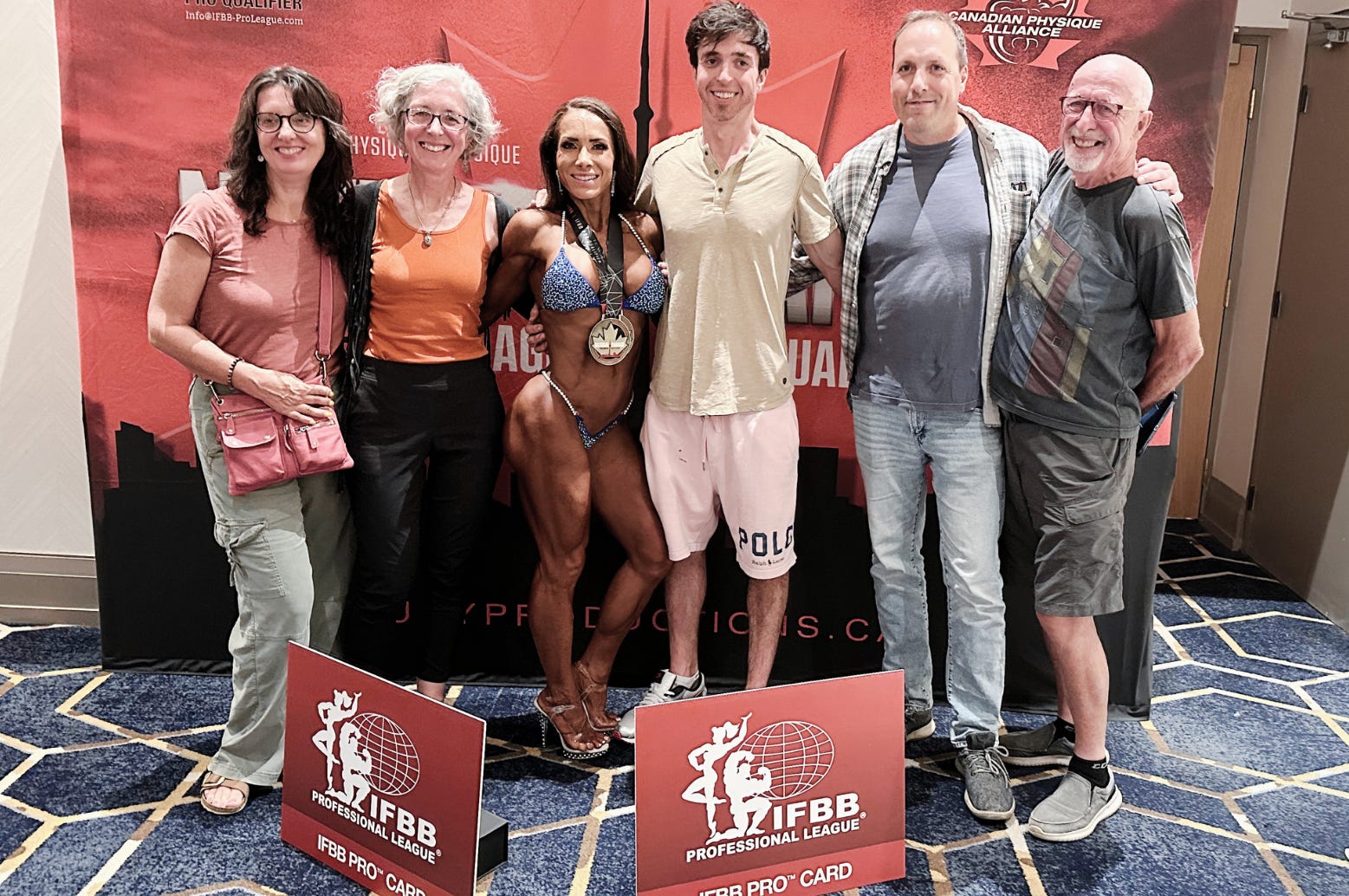
It was summer and I’d just won my IFBB pro card as the Canadian Natural Wellness Champion — a pursuit that had taken a decade of consistent, disciplined commitment. I was back in Ontario visiting my family, who I’d see maybe once a year for over a decade.
I had the chance to jump straight back into prep and do my pro debut at the Ben Weider — the event where I could qualify for the Olympia, every pro’s biggest dream. But throwing myself at the foot of a new mountain meant leaving the summit I’d just reached without appreciating the view. It also meant less time, and less attention, for family.
I had many friends from growing up in Niagara and living in Toronto. Many, many friends. Not one of them came to my show. You know who did? My family — including my 82-year-old grandfather, who drove from Fonthill to Toronto and back to watch his first, and as it turns out, last bodybuilding show ever.
That summer was the last time I saw my grandad alive. He died the next spring, before I could get back.
I didn’t know it then. I see it clearly now. I had made it my whole identity to become a professional bodybuilder — the coaching practice, everything built around it — but my family values ran deeper than the identity ever did. Just because I could compete that same year didn’t mean I should. Every decision has a cost.
Maybe I’ll never compete at the Ben Weider. Maybe that was my one shot at the Olympia. I’ll truly never know. What I know now is that I will die one day, and all of it — every superficial achievement — will mean nothing next to having shown up for the people I love while I still could.
The opportunity cost of that summer with my family is not a price I will ever be willing to pay.
You’ve been told your whole life you could be somebody. But you already are somebody — the question was never whether this was true, only whether you’d notice before the noise convinced you otherwise.
So before the next temptation of more arrives, and it will, find the thing about who you are right now that you’d be unwilling to trade. Not the title, the possession, or the achievement, but what is underneath all that. When you find it, sit with it long enough to feel it in your body.
That feeling is the measure. Everything else is just more.
❀ ⛰︎ Holding fewer rocks, making space for flowers, and enjoying the view, alongside you, SJT
Hello human reading this - I am a NEW writer and I want to get better at writing. If you actually read this and made it to the end ANY FEEDBACK - no matter how blunt or hard- is genuinely and truly appreciated.
I’m a professional bodybuilder so studying our weaknesses and working to make them strengths through specific criticism is my jam. I really want to improve my studying human impressions before asking the dreaded AI-bots. THANK YOU. 🙏🏻