

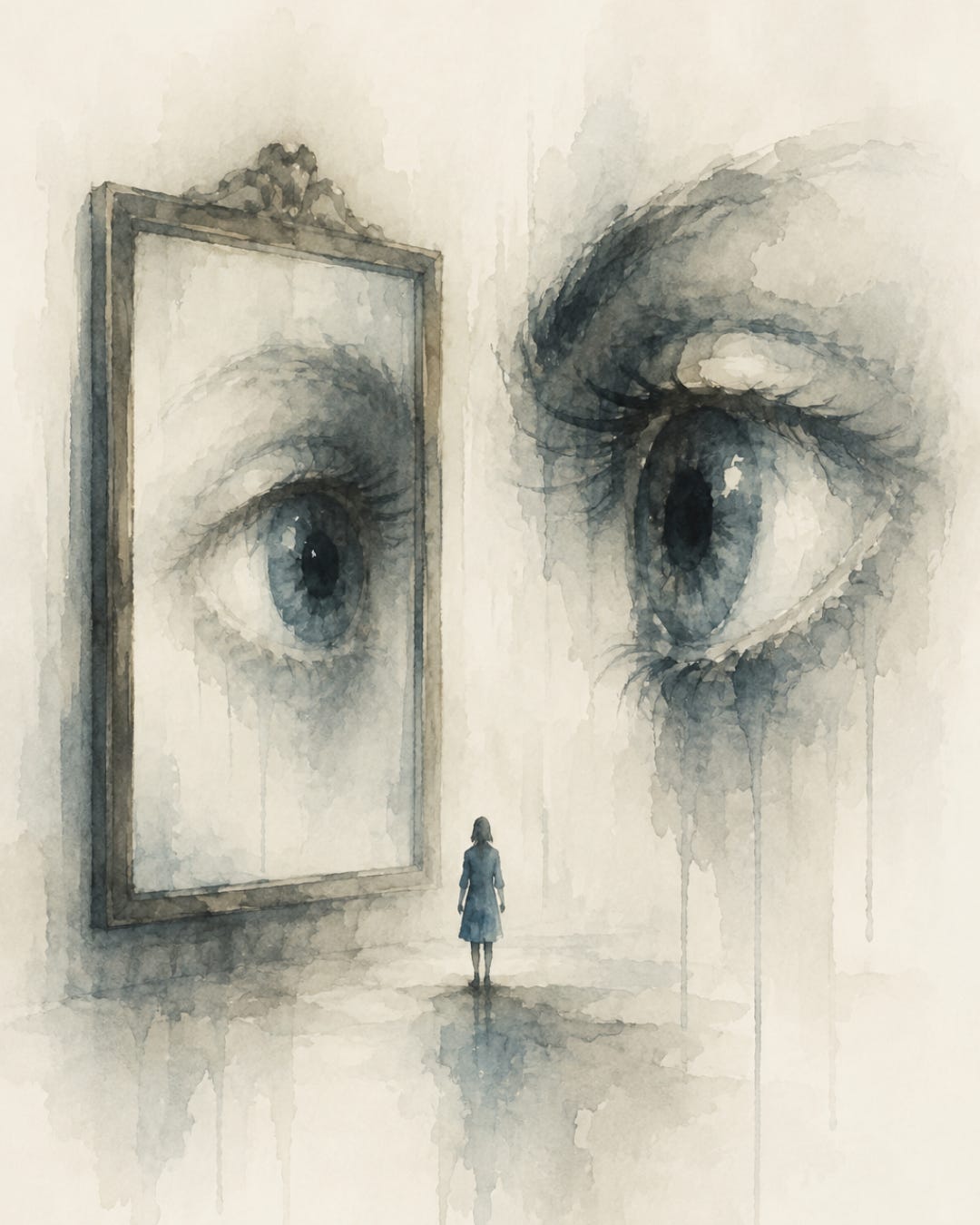
How often do you look in the mirror each day? Maybe a quick assessment before leaving the house and a short review again at night?
When you look, how many times do you raise your eyes to meet your own reflection? How often do you hold yourself in your own searching gaze? And when you look, what are you looking at, or rather, what are you looking for?
You know what you want to see, and you are aware of how you seek to find it and look for how to get it. What you scan for in the mirror is confirmation of something you’ve already decided on. Approval. Or disapproval.
You no longer look to see yourself as you are but only as a measure of who you want to be. The gap is where you monitor change and determine how good or bad you have become. You actively search for what you don’t want to find by asking the same routine questions:
“Am I getting older?”
“Do I look tired today?”
“Is that a grey hair? A new line?”
“Are those bags under my eyes? Why are they always so bloodshot and weary?”
You strain over the reflection of the one in the mirror searching for what is broken to fix, what’s lagging to improve, what is not right and needs to change to make you more like how you want to be because you think that if you could just look a certain way, you’ll finally feel a certain way, too.
Maybe you want to be accepted, celebrated, loved, and taken seriously; or perhaps you want to belong, to be heard, to feel like you exist and that you matter. Unconsciously, you have been collecting, storing and making meaning from a lifetime of feedback that showed you on the most primary, superficial level, the ‘better’ your appearance, the more responsive the world was to offer any semblance of the feeling you seek.
But even when you’ve felt it, even when you proved to everyone out there that you really are the one you’re trying to be, the one you think you need to be to feel it, it wasn’t persuasive or compelling enough to convince you that it was actually true. The world rewards a good appearance with the same shallow examination you offer your assessment in the mirror. That’s why you keep looking, and why you need the world to keep looking at you and with you.
The approval you seek is conditional on the maintenance of what’s being approved, which is not anything like the actual belonging, acceptance, or love that you want.
The world cannot confirm it for you or give it to you because it cannot see you well enough to offer anything but the superficial notion of what you want. You only get that from depth, understanding, and real contact.
The shallow evaluation that nods to confirm your approval is a quick and non-invasive hit that gives just enough to carry on with your day in a restless, begrudging acceptance but never delivers ease or assurance sturdy enough to not keep checking.
It is an entry point to proceed that you confuse with the whole experience, only to end up at the same gates of assessment without ever entering the space where the very action required to show you what you want to feel takes place. You look in the mirror and stay looped in the same line, but never cross the threshold or pass through the door. All you confirm from outside is that you are in fact, in the right line to get what you want, or not.
This has always been a structure of our species but modern internet culture exemplifies this.
The internet was one of the greatest breakthroughs in human history. For the first time, nearly the entirety of human knowledge became accessible to almost anyone with a connection. It should have been a cognitive revolution. Instead, it is now an emotional one.
Rather than using the internet primarily to expand our understanding of the world and each other, we increasingly use it to regulate how we feel about ourselves. Social media transformed the internet from a library into a mirror where every interaction serves as a way to glimpse in the mirror and confirm we are still ‘good enough’. The currency shifted from information to validation where every notification is a tiny possibility of acceptance, every “like” is a micro-dose of social reward, every comment is feedback on our place within the tribe, every scroll is another opportunity to compare ourselves to thousands of people we were never meant to measure ourselves against, let alone know every detail of their carefeully curated existence.
Eventually, the constant stimulation diluted our sense of self so fundamentally that we began checking not only as a way to confirm our sense of approval and belonging, but more insidiously, we started checking as proof to confirm that we were still here.
It was no longer just about if we still matter, but also that we exist. In a matter of years, we transformed the greatest information network in human history into the world’s largest emotional regulation system. We took perhaps the most powerful educational tool ever created and reduced it to a machine for outsourcing self-worth.
Here we gather online to find ourselves staring in the mirror, hardly aware that we are separate from it, and nearly void of any concept of self-perception without it. We collapsed the distance between ourselves and the mirror nearly so completely that we forgot we were looking in one at all.
We abandoned the feeling of being within ourselves, as the one inside the body who looks. We get entranced by all we see and our eyes jump around quickly, landing on nothing yet still attempting to take it all in. We form loose impressions by compressing many fragmented observations into a single, simplified conclusion without really seeing any of them.
We no longer experience ourselves as the one who looks, but as the thing being looked at.
The observer and the observed collapse into one, and without that distance, there is no space for curiosity, compassion, or recognition. There is only assessment.
We have become both the one searching and the one being searched for, endlessly scanning ourselves for evidence of whether we are enough, while becoming increasingly disconnected from the one who was there before the search began. We mistake observation for awareness, evaluation for understanding, and the ability to see ourselves for the ability to truly know ourselves.
What you seek is not absent from where you look, but is hidden from you in how you look.
It is not something that can be scanned for quickly and resolved with a fast conclusion —that is a way of looking that needs constant reinforcement. It’s the depth with which you are willing to seek and the discomfort of the unfamiliar contact without pulling out prematurely by assessing what you see about the part of you who looks.
There’s no meaning to be made from seeing yourself. There’s nothing to measure or deduce any conclusion from the contact. There is only the contact itself.
Trying to explain or evaluate it is to impose worldly measures on something entirely otherworldly and it’s that precise admission — that something in you is otherworldly, unknown, beyond definition and description — is exactly why it is so uncomfortable, almost unnatural, about seeing it.
Yet the more you look to really see yourself and the longer you allow yourself to be seen, the less you need confirmation of what you already know if you let yourself feel it without forcing the feeling through some lens you were trained to accept and believe, like the one that you’re not enough or lacking in some way or incomplete and separate. The one that asked you to forget the truth about who you are.
The humorous bit is that the self that you are searching for is the same self that is doing the searching. You cannot find yourself as an object because you are not an object to be discovered. You are the awareness that has been present through every attempt to define, improve, prove, or become.
The moment you stop reaching outward for evidence and grasping inward for conclusions, you meet the part of yourself you thought was missing. The bit that got buried beneath the constant need to interpret, assess, explain.
How to see yourself as you are, and not as you appear to be:

Look into the mirror, but not like you do in the morning or when you’re trying to find something to accept or change.
Look again, look deeply, and really look for the one who seeks. Look in the mirror and this time, actually make contact with your own eyes.
Look into each eye separately, then together, then separately again. Look as deeply as you can with an open curiosity. Resist the urge to withdraw when discomfort rises but instead, hold your gaze. Notice the instinct to search for something to evaluate.
Are the eyes red and bloodshot?
Is the pupil large or dilated?
Are your lashes thinning?
Do the eyes look tired or strained?
What flecks of color flash and which ones fade?
Notice, and then release all that and look again.
Observe any friction— rising uneasiness, awkwardness, or restlessness — and your desire to respond by breaking contact with yourself. As the pressure to pull away swells, do something uncomfortable and stay just a beat longer than you want to. Challenge yourself to be inside the discomfort of full presence with yourself for a moment longer than feels tolerable.
If you lingered, you made contact. You just caught a glimpse of who you actually are when you’re not masquerading and parading who you think you need to be. You saw a glimmer, maybe for the first time ever, of your most true and honest self.
You might be tempted to look again, but it’s time to exit the room and leave the deep mirror gazing alone for the day. There’s no need or even benefit to intellectualizing what you think you saw. Do not get caught up in rumination or attempt to make sense of what you witnessed, nor what you think it means.
Go on with your day and live your normal daily life.
We are collectively starving for authenticity, especially within ourselves, but do not be seduced by your hunger.
A brain that concludes quick interpretations from shallow observations is only a threat to the truthfulness you seek.
A mind that rushes to reclaim authority by returning to stare at that which it does not yet understand will only be met by a reflection that terrorizes the inner world.
What you long for can not be satiated without depth.
And real depth takes its time.
You can not force depth with frequent, fervent hits.
You will not find yourself in deep places until you stop clinging to every surface.
When you look, there is much you may see. But one thing you will not see is demons, monsters, or phantoms of dark creatures set on your possession and consumption. But if you don’t know how to embrace both your light and your shadow with equal recognition, your head will easily mistake the pieces of you that are startling and unknown as malevolent.
It is our human tendency to make predators of what we do not yet understand.
The goal is not to see and rush to recognize or accept what is there. You do not need to instantly interpret and internalize. In fact, that is where the only real danger lies, in projecting and attaching to a false story too soon.
Although it is a common, prevalent reaction, particularly in a world flailing for comfort and certainty, it only further damages the psyche and your sense of self.
What you see first does not seem like it belongs and that’s why it feels scary because seeing it means confronting that it does. It is an inseparable part of your true essential self.
It is the work of a heavily burdened unconscious that defaults to a conditioned reflex to distort what is honest and true into something threatening and hostile. A mind still inexperienced with the divine eternal within will maladaptively leap to assert power by warping reality, polluting it with the old corrupted patterns. You do this automatically and instinctively under the guise of safety and control long before you are ever conscious of what’s formed beneath the surface of your awareness. But the world is not always safe and almost all of your life is well beyond control. If that does not feel comforting to hear, it’s even worse to accept.
But once you do, the carefully orchestrated illusion you designed to contain your life force begins to dissolve; the illusion that you could take something so infinite, so fluid, so alive, and force it into a fixed shape. You believed that with enough rehearsed consistency, you could condense and contain your whole self along some narrow continuity, and call it identity.
You are not an abstraction that can be reduced to just one thing, not even a handful. You are the living expression of dimensionality, nuanced and emerging in a wholeness far outside description. You are not a category, but a constellation.
Who you know yourself to be is not all of who you are. It is simply all you have allowed yourself to know and to experience once you created the pattern of being that way and the world reinforced it. What you repeat reveals parts of you but not the entirety of you. You do not feel whole not because you are lacking or broken, but because your awareness of your wholeness is incomplete. The feeling is not wrong, only unfinished.
There is so much more to you than you know. When you dare to cast a wider vision, you invite yourself into a greater belonging where you are not left unchanged by what enlarges you. Once you see, extraordinary breakthroughs and rapid transformation become everyday and ordinary.
This is why miraculous change suddenly happens in new environments or with new people because they expose and encourage you to express alternative ways of experiencing the world, and yourself, through it. When you interrupt the congruent expectation by seeing differently, you update what you look for in the one who looks. But you’re not seeing something new, you are seeing what has always been there, only now with new eyes that allow you to see more. And you don’t need to endlessly pursue unfamiliarity to see it, you need only observe what is unfamiliar by surrendering what’s expected.
You can try this any time by looking for yourself in the mirror and making eye contact with yourself long and deep enough to encounter a flash of something else.
Discomfort will tell you to come back and keep checking. But that is not a reason to. It is not something that requires daily or constant commitment, though there may be times in your life where it serves as an essential guidance.
You can only touch what you are willing to reach for. If you desire a profound connection, then be prepared for a penetrating exploration. An untrusting glimpse that is guarded by shallow confirmation is only going through the motions that created the very dependency to keep searching.
You cannot find what you are unwilling to know.
Many people use their eyes, and still they do not see.
The further you look, the deeper you witness. The larger the depth of your gaze, the greater your sense of knowing yourself. As you become more comfortable with being seen, you will release the impulse to recede or reject what is there. Although the mind may still instinctively create stories and meaning, sovereignty will strengthen as you choose to accept and integrate before you intellectualize, interpret, or overanalyze.
The feeling is the measure; everything else is just more. The feeling is your knowing of what is real before the world asks you to demonstrate that it is true. When you are willing to be deeply present with yourself, you learn to validate your own unequivocal truth. You now carry a powerful sense of knowing that is so irrevocably and profoundly felt that you no longer need to see to believe.
To be loved is to be seen. To be fully, transparently witnessed is to be held in the very light of awareness and acceptance.
When you have the courage to invite all of what you see into the full embrace of who you are, whole and complete, you are able to elevate not only yourself, but all that is alive and has been alive into an indescribable, undefinable bliss entirely beyond words.
And if you’re really brave, without breaking your own gaze, speak these words with your own voice out loud and without trying to listen to the mind for confirmation, but let yourself really hear them:
“I love you, and I accept you, unconditionally.”