

There is a version of you that has been waiting a very long time to stop negotiating with herself.
You have been negotiating for as long as you can remember. With the mirror, with the scale, with arbitrary numbers that came to define your worth, with a society that handed you a program and called it a goal, with an industry that showed you a before-and-after and called it a transformation, with a belief that convinced you a smaller body was a better life.
You have been negotiating with the part of yourself that says not enough and the part that says too much, and you have been exhausted by the distance between them.
This is the story of what happens when you stop.
My body grew too fast, too early.
Then it got sick.
Then my mind got sick.
Then I gained weight.
Then I lost a lot of it.
Then I started lifting to fix my brain.
Then I got sexy.
Then I got strong.
Then I got fluffy.
Then I got on stages incredibly lean.
Then I got fixated on the idea that I was too small.
Then I got interested in what my body could do beyond just how it looked.
But I still really care about how it looks. And I’ve decided I’m allowed to like that about myself.
And all the while, the world made its judgments.
The truth is, I have never been just one thing, and I wouldn’t want to be.
This is what they don’t tell you about the journey: it isn’t linear OR fixed, and it isn’t supposed to be.
The woman who competes on stage in a sparkly bikini and full-glam IS ALSO the woman who just wants to deadlift, looking fully undone and grunting like SHercules.
They are not contradictions. They are chapters and often also sentences within the same paragraph about who she is now. They are evidence of a self that keeps evolving, keeps asking, keeps refusing to be reduced to a single story.
But the world wants a single story. It wants to define us in neat containers of fixed before-and-after. It often wants the destination to be smaller, quieter, more manageable. It wants you to show up to the weight room because you hate something about yourself, and it wants to sell you the cure.
I didn’t start working out to lose weight. But that’s literally the only reason the industry thinks women show up.
Here is what I think is actually happening when a woman picks up a barbell for the first time: She is trying to find out what she is made of.
She is not trying to disappear. She is trying to arrive at a new conclusion about herself.
She is trying to discover that her body is not a problem to be solved but a capacity to be explored.
She is trying to challenge the limitations imposed on her by a culture that wanted her to be easier to control.
She is trying to find what is on the other side of I can’t by asking instead, what if I try anyway?
She is trying to feel strong and sovereign by taking up space how she wants to and coming home to herself after a very long time away.
But we have been taught to distrust that instinct. We have been told to redirect it. To take the raw, animal desire to be powerful and whittle it down into something more socially acceptable: a smaller waistline, a lower number, a body that takes up less space and makes other people more comfortable.
As if shrinking were the only ambition available to us. As if the weight room were just a waiting room for a body someone else would finally approve of.
Most of my life, I’ve struggled to accept my body, much as I’ve struggled to accept myself. I constantly felt like I was not enough, or that I was too much, and spent most of my life oscillating, sometimes violently, between ideals that are supposedly mutually exclusive.
Soft and strong. Smart and strong. Sexy and strong. Feminine and fierce. Delicate and dangerous. Visible and taken seriously.
The worst offense that culture gives women is convincing them that these things cannot coexist. That you must choose. That the version of you that wants to be seen cannot also be the version of you that wants to be respected. That the version of you that cares about aesthetics is somehow less evolved than the version of you that has integrated them.
I’ve chased leanness, and size, and numbers on the scale, but I never found what I thought I was looking for in any of it.
I’ve sought approval and criticism on stages, I’ve implored my reflection in mirrors, and searched desperately in the eyes of those who I thought could give me answers as I asked over and over: Is this enough yet?
The answer was always conditional.
What I know now is this: the goalpost was designed in a way that it never stops moving. A moving goalpost keeps you consuming. It keeps you coming back for a version of more that you will get close enough to almost embody, but can never fully keep. It convinces you that you are always just one program, one adjustment, one better version of yourself away from finally being accepted, awarded, applauded in your actualization of enoughness.
You will never be enough on those terms. The terms were never designed for your liberation but instead, for your dependency. It’s not that you are not enough; it’s that you can never be enough (or stay enough) for the standard someone else tried to convince you was your own.
I didn’t start working out to lose weight. I just wanted to feel in charge of my brain again, and as the body led the mind to heal, so the mind led the body to do the same, and suddenly, I could never see myself through the same lens again.
I didn’t start working out to get smaller. But that’s literally the only reason marketing tells us we should. As if the reason we feel less than is because we are not yet in the body that the world will approve of.
Thankfully, the cause is also the cure. Somewhere between reps, sets, an ungodly amount of protein, some tears, and a ton of sweat, we finally get it.
My body is still one of my favorite projects. But it’s also a vehicle. A home. A history. Evidence of everything I’ve survived and chosen and overcome and built from scratch.
This is what it means to become sovereign in your own body: not that you stop caring how you look, but that you stop outsourcing the meaning of it.
It is less about transcending or rejecting vanity, but more that you stop allowing how you look to be weaponized against you.
The truth is, even if you achieve some illusion of a final, fixed form, the only promise is the inevitability of change. And I will tell you firsthand that the maintenance is often much more maddening than the pursuit.
Eventually, you come to accept that you are the only one who gets to determine what this body is for. So what are your terms?
I personally do not want to be small or huge or even the strongest. I also don’t want to perform a standard of beauty and belonging for an audience that moves the goalposts the moment I arrive.
I want to feel good in my skin, move well, lift heavy things, and still feel like a force of nature. I want to be soft, strong, sexy, smart, and so much more in my own definitions of what those mean and when. I want to take up space and create more space and take that up, too.
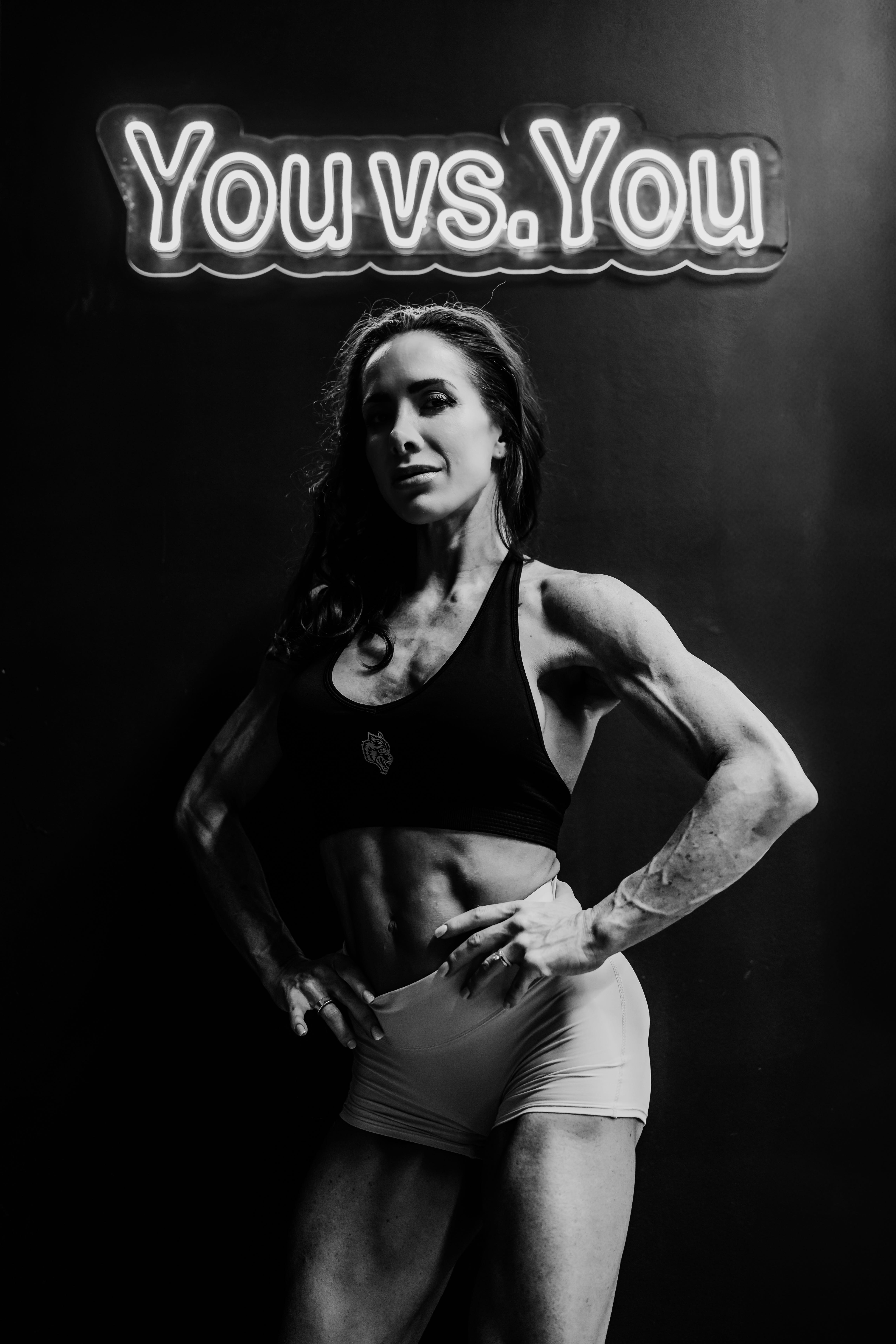
Strong and sovereign is not a final destination, but a decision you make, and then remake, on the days when the old voice comes back - and it will come back. It will whisper that you’ve become too much, or you’re still not yet enough, that you’ve let yourself go, or that you should be further along by now.
And on those days, the work is not to silence the voice (though heavy deadlifts do a long way in drowning it out). The work is to recognize it for what it is: the echo of a world that doesn’t know what to do with women who refuse to make themselves smaller.
That is not a truth about you, it’s a truth about the world. An old world that’s being progressively rebuilt by us, the strong and the sovereign, who stand up and build it.
That’s why I want to be strong and sovereign.
Setting, chasing, achieving goals for my own satisfaction and figuring it out as I go alongside other women steadily doing the same.
And as it turns out, that is not only more than enough, it is everything.
- Stronger in sweat with you - SJT ⸜(。˃ ᵕ ˂ )⸝♡
For all the women who have been negotiating with themselves for too long.