

This is part four, and the last of the free series on self-sabotage. It began with Why knowing yourself more isn’t working and moved through You are the stories you tell, and Becoming someone else will cost you who you are. This is the far side of the room you fought so hard to enter, and the work of staying in it.
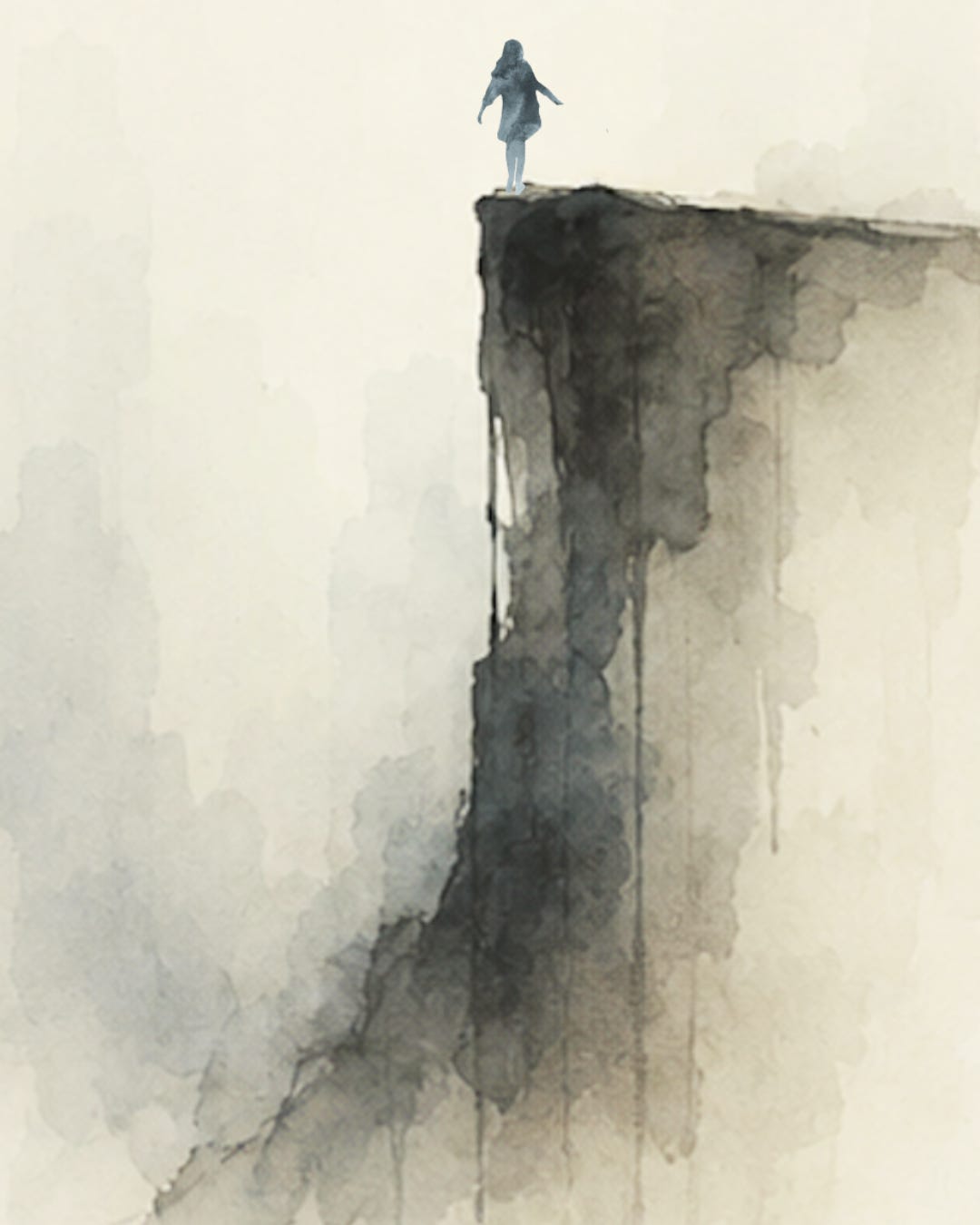
You know yourself deeply and still can’t get out of your own way.
You have done the work and yet you remain blocked.
It’s not a lack of awareness.
It’s not a story that keeps you stuck.
It’s not a shortage of understanding or preparation.
It’s that you continue to think the way forward requires you to do something when it simply asks you to be.
You block yourself by what you do. And you do a lot.
You keep adding to a collection of saved posts of what you want.
The baby blue Porsche with the tan interior.
The eclectic home filled with curated paintings tucked up beside the ocean. That amazing dress from that designer who just knows a woman’s body—how great you would look in that dress!
The endless exotic vacations you greedily ogle past your bed time as you slip into restless dreams of rehearsed visualizations of how you think it will feel to be there, with all that.
You mistake the absence of a feeling for evidence that you’re in the wrong place.
When you can’t go forward fast enough, you end up reaching back.
You still check the weather in the place you want to be, the one you just left. Not the one outside the window you avoid because it’s jarring to face such a different reality. You look back at the one you keep a second clock for, the place with the rain you can still feel.
You romanticize what was and inflate the old feeling until it outruns every reason you had for leaving it.
Your body starts making subtle preparations to move again. Long before your conscious mind is aware, your nervous system primes a return to the familiar by rehearsing old routes, reaching for old habits, and relying on predictable patterns of a life you thought you left behind. Without actually agreeing to it, you’ve begun orienting toward the door your conscious self swore it was done with.
Without letting yourself land where you are, you are persistently pulled by the expectation that arrival will deliver certainty or peace. You believe if you could just reach that final destination or achieve that finished state you will finally feel what you think it takes to let yourself be in your life.
But there’s nothing to get and there’s nowhere to go.
•••
Instead of enjoying where you are, you trace the old limitations over the new space and hesitate at imaginary edges because freedom still feels like trespassing.
You lean forward only to check back. You can see where you want to go, but something stops you from continuing to move toward it even after crossing the threshold that brought you here.
Although you are not in your former conditions, the old sensations from the past echo with a continuity that restricts you in the present.
You freeze despite all reason, and even desire. You live like the dog who stands in the yard with their head down exactly two steps over where the invisible fence used to be, the electric collar long removed.
You are able to move forward, to inhabit more—but you don’t. You know everything you need to know, more even, and still can’t get out of your own way. Your constraint is gone. Nothing is stopping you now but you.
There is an invisible tether to an internal story that still insists on being true. The world is no longer drawing any lines—you are. The conviction that you will always remain who you have been becomes so self-generating that it no longer needs validation from reality because it now enforces itself.
You hauled your block all the way to the new space, and were still surprised when you gravitated toward it. It was you who brought it here. The block is a myth that’s only maintained by the habit of stopping yourself right at the edge of everything you actually want. It’s not held by anything other than your commitment to carrying it.
You’ve done everything right. You got to where you want to be, but it doesn’t feel the way you thought it would. It’s not familiar yet. And soon you find yourself subtly drifting back toward the door. The real threshold, the one you worked so hard to cross, that opens onto the hallway where you swore you don’t want to return.
You are frustrated because you know better, yet here you find yourself, retracing your steps, slowly erasing progress as though you are reeled back by a version of you that won’t let go.
But nothing is actually pulling you. The magnetic tug is really a default to the part of you that has yet to fully release the old allegiance. The truth is you don’t yet know how to be yourself here so you recite the old internal rhythm that leads you back to where you just came from.
You have moved but you feel held back by the old world not because anything is actually holding you, but because you never untethered yourself from the thing that did.
You know better, but your authority is still coming from the one who narrates your life instead of the one who lives it.
And here, you learn the self who understands is not the self who governs.
You begin to govern the moment you stop letting what used to be true decide what you do next. It’s when you sit inside the tension of the formless state while it’s still developing into shape and decide that not only will you stay in that discomfort, but you will actually allow it.
It’s the courage to remain in this reality longer than the memory of the old one.
•••
In that pause, you may still feel a nudge to move away, back, to somewhere else other than where you are. Sometimes you feel pulled because you are still attached to an old wound. Other times you are simply registering a new signal, an accurate truth about bad ground.
On the surface they’re identical. Both bring resistance, both insist not now, not this. That’s exactly why the feeling itself can’t be trusted. They separate underneath.
A wound resists because moving threatens who you have been.
A signal resists because the ground is not able to hold the growth yet.
Distinguishing a true signal from a wound in disguise is the work. Life will ask you to move before you know with any certainty. You can’t tell for sure if it’s you or if it’s the place. Sometimes the truth is that it’s both. It’s not easy and there’s no short-cut.
•••
You arrive without the confidence to fully be there. You’ve stepped into a new room only to find it full of strangers and strange conditions. The novelty disarms you. You feel vulnerable, shy, exposed because although you wanted this, anything that doesn’t match your expectation collapses your faith that this is actually where you are meant to be.
Nothing is wrong, but it’s also not quite right. What is it?
You make yourself dizzy trying to find it.
You scan for something you might recognize as a safe place to land and collect yourself. That you might brace yourself against something familiar.
A faint vertigo creeps up the more you spin looking for it because that’s the thing about being fully untethered. When you dissolve the old attachment and release the wound, the same freedom also feels like floating in a void before you learn where and how to anchor.
You exist in a gap filled with uncertainty and crowded with doubt. You recognize where you are but you haven’t put down markers to belong yet.
What is quiet is not absent.
You are physically present but not yet settled into trusting what that means. Your becoming runs behind your arrival.
And so, hovering in the middle of what you wanted, you settle on the one conclusion that can quickly get you out of the grey: the feeling is wrong, so the place must be.
You don’t immediately declare it but you quietly decide: I don’t belong here. This was a mistake. I want to go home.
But the discomfort of arriving in a new place without knowing how to be there is not evidence you made a mistake. The mistake is making a verdict before the experience has finished landing.
You decided you made the wrong move because you couldn’t sense how you belonged to it. But you can’t belong to where you haven’t been.
What’s absent isn’t missing, it’s just not accessible until after you stay.
Yielding to the impulse to explain before you understand is how you misinterpret what’s fully there.
The real wrong choice is what you do after you can no longer tolerate feeling so foreign. It comes either from reaching back toward the old door, or from rushing to collect and define the space—to curate false understanding before you’ve lived in it.
The gap is its own threshold you must endure if you want to stay. One you have to learn to survive despite the instinct to see it as a problem to solve.
But you cannot simply wait for evidence to arrive, you have to be there long enough to find it. The proof doesn’t come from waiting, it is on the far side of the staying.
What you seek is never going to meet you at the door. You have to put your feet down onto what’s not steady and participate in it enough before you can know. Arriving only confirms that you are somewhere new—living there confirms if it’s right.
You keep telling yourself, “I’ll know when I belong here.” But you have it backwards. Knowing comes much later, never first.
Discomfort is not evidence of a wrong choice, but confirmation of real movement.
•••
The desire to leave does not mean you made a mistake, and neither does it make you wrong for feeling it.
Lack of conviction is not a personal deficit but a territorial one.
Moving across the threshold from your old life to your new one cost you the stability of what was familiar.
You’ve stepped into the new room but part of you hasn’t finished processing that crossing. The change in you follows the change around you.
Even change that you choose doesn’t always feel good, and there’s nothing wrong with you if you notice that.
Expecting to seamlessly transition from one world to the next and instantly regain your composure from your own rearrangement is what makes it feel like failure.
Before you can measure what you’ve gained, you’ll notice all you lost.
Crossing is the moment of faith. Staying is the longer work of courage. You don’t stay because you feel like you belong—you stay, and belonging follows.
Courage is the resolve not to harden into a single, finished self. It’s the willingness to stay unfinished.
The goal is not to become someone without blocks, but someone who stops organizing a life around removing them—a life that is no longer one long sequence of striving through various stages of becoming. The aim is not control over identity, or even the discovery of a truer one, but the capacity to participate more than you manage.
This is where sovereignty parts from self-help and self-knowledge.
Self-help asks, “Who should I become?”
Self-knowledge asks, “Who have I been?”
Sovereignty asks, “Who am I choosing to be today?”
Sovereignty is the capacity to live from where your life has already arrived—faithful to present reality rather than a memory of the past. It is what governs a life no longer led by the voice of fear, but by the one who actually lives it.
And from that authority, the door stays available. Leaving again is not an escape or self-sabotage, but a fully chosen act, once the room has done its work.
Sovereignty is not a refusal to ever leave, but a refusal to let the impulse to flee decide for the whole self.
The series gave you the why. The Studio is the how: the practice that pulls you through by overriding understanding entirely. The discipline of living what you know is now available for paid subscribers. This is the way out of the paradox that trying to think your way out created.
Separating the wound & signal is a lifetime skill. 🌿 And, belonging isn't decided at the door. It's assembled slowly, in the body, from a thousand small confirmations that the new place can hold you. So you're right, staying isn't stubbornness. It's giving the map time to draw itself. Nice piece Sarah.